(This article is a follow-up from the ones published in previous weeks, episodes 0, 1 and 2, and more episodes will be published in the upcoming weeks)
Nowadays, mobile phones can stay switched on for many days in a row. But every now and then, they need to be restarted, and as part of the restart process, they perform a series of tasks and updates that allow them to continue to work optimally.
Luckily, as humans, we also get to reset our system once daily, and we can take advantage of those special moments at the beginning and the end of our day to get back to our centre, check in with ourselves and evaluate our goals and priorities, so that we can live every day from a place of intention, making our own decisions, instead of simply reacting to whatever happens and getting carried away by the day's events.
When getting up
What can you include in your morning routine to help you start the day on a positive note? It doesn't have to be fancy; the most important thing is that it works for you, because that's the time you're devoting to yourself, to your own personal development.
Here are a few suggestions:
Breathing consciously
Planning/visualizing your day
Reading an inspiring book
Writing down your thoughts
Repeating positive affirmations
Being thankful for what you already have
Meditating
Doing some yoga or stretching
Going out for a walk or run, playing a sport…
Preparing a special breakfast for yourself
Before going to bed
You can use these same ideas for your bedtime routine, or if you prefer something simpler, I suggest writing down four things in a notepad using the Spanish acronym AMOR (LOVE):
A for Agradecimiento – THANKFULNESS: What do I feel thankful for today?
M for Mejorable – IMPROVABLE: What did I aim to do that I didn't achieve? What would I do differently?
O for Orgulloso - PROUD: What was I able to achieve today? What obstacles did I overcome?
R for Reflexión – REFLECTION: What surprises did I find along the way? What did I learn?
What do you think about these ideas to reset yourself each day? What works best for you?
Just as computers and mobile phones are configured with factory settings that allow them to perform certain functions more efficiently, we, as humans, come with specific characteristics and natural tendencies, que hacen que unas tareas se nos den mejor que otras. Cuanto mejor conozcamos esas «prestaciones», las nuestras y las de los demás, mejor podremos aprovecharlas para entendernos y comunicarnos mejor.
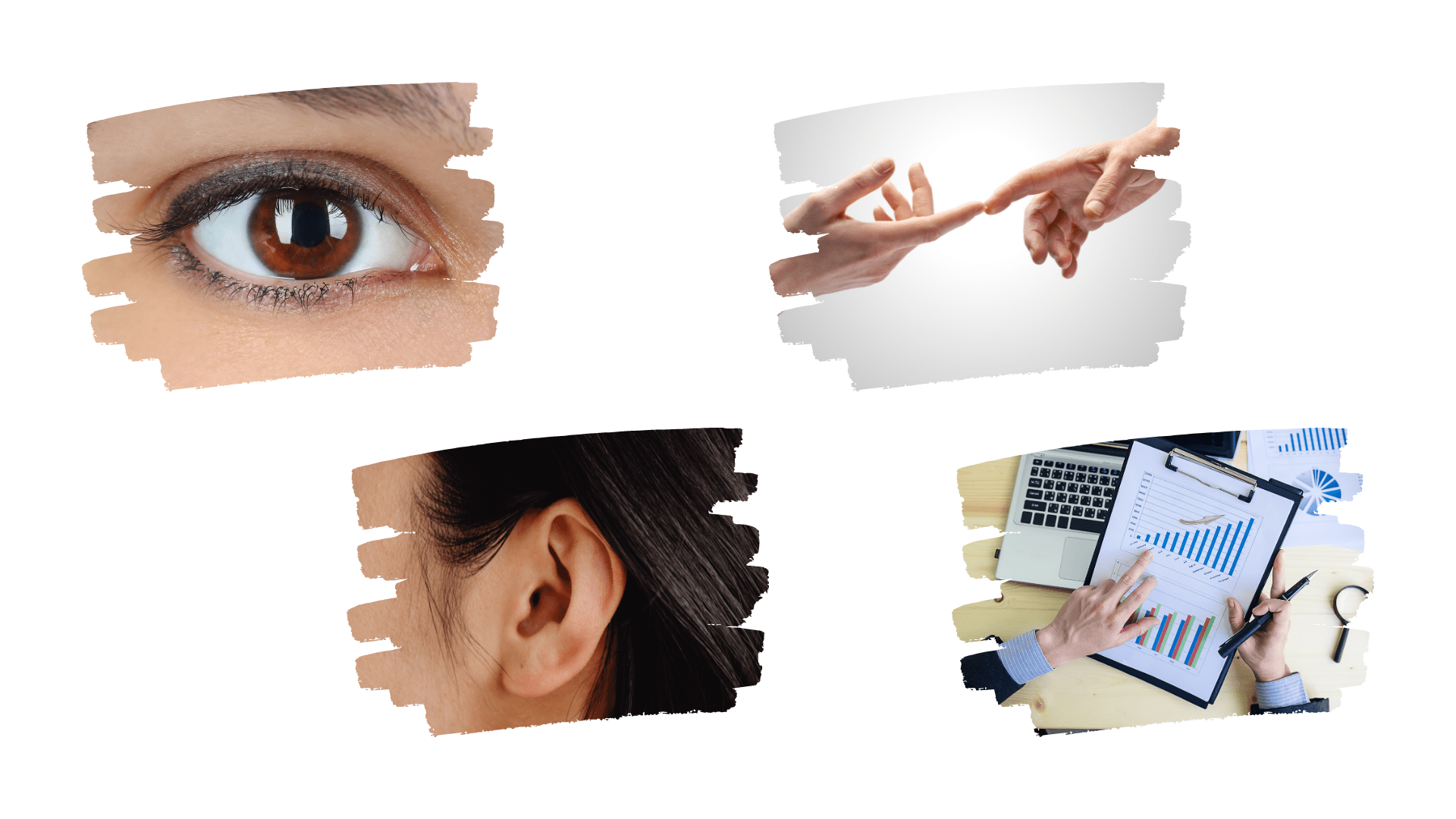
From before birth and throughout life, we human beings perceive reality through our five senses: sight, hearing, smell, taste and touch. Most of us naturally rely more heavily on certain senses and less on others, which determines our understanding of the world and influences our behaviour and means of self-expression.
Based on all this, the field of neuro-linguistic programming defines several different ways to represent reality: they´re the so-called representational systems: visual, kinaesthetic, auditory and digital.
Most of us have a dominant representational style, though, in reality, they´re all present in us in varying proportions. Ideally, we want to work on all the different styles so that they´re well-balanced, and we have the ability to choose which one to use depending on the situation, as each style is particularly useful in certain scenarios.
Each representational system can be recognized by the use of certain words and expressions, in addition to coming across through a person´s gestures, skills and behaviours. Let´s see them one by one.
Visual
Think and speak in images
Pay more attention to visual details, faces...
High level of energy, always doing something
Value image, dress smartly, want to look good
Usually keep their house/workspace tidy
Speak quickly, loudly and clearly
Think quickly, learn quickly, also forget quickly
Good at getting the big picture of a situation
Upright posture, looking directly at the other person
Often use their hands to express their ideas
Keep some distance from the other person
May get angry but don't hold a grudge
Sample expressions: in plain sight, it looks good, we´ll see...
Kinaesthetic
Register their experience of the world through their body and their feelings, and that's how they remember
Relaxed, easygoing, very sensitive
Dress comfortably, not interested in fashion
Move slowly without rushing
Submissive posture, keeping the gaze low
Speak slowly, softly and quietly
Learn slowly, through experience
Once learned, they don't easily forget
Seek to be close to others, contact, touching
Usually fun to be with, hate conflict
Can hold a grudge and seek revenge
Sample expressions: a heated discussion, between a rock and a hard place...
Auditory
Use sounds to create experiences
Pay more attention to auditory details, what others say and in what tone, and that's how they remember
Relaxed level of energy
Dress comfortably, don´t care what to wear
Tendency to look down
Not looking when listening - need to lend an ear
Annoyed by loud and screeching noises
Struggle when there´s a lot of background noise, unable to filter it out; they hear everything
Auditory and digital are often confused
<1% of the population is primarily auditory
Sample expressions: it rings a bell, sounds good, call for attention...
Digital
Have a need to make sense of the world, to figure things out, to understand
Think in a very structured and logical way
Show very little emotion, like to think things through
Learn by working things out in their mind
Memorize steps, procedures, sequences.
Value precision, choose words very carefully
Make decisions based on logic, facts and figures
Spend a fair amount of time talking to themselves
Adopt a sideways posture, keeping some distance
Prefer not to look directly; quickly look away
Speak in a monotonous and repetitive tone
Sample expressions: it makes sense; step 1, step 2, step 3...
Interesting, right? It's almost as if each one of these styles is a different language that we speak without realizing, and when we find people who perceive things and express themselves in a way that's different to ours, that's when misunderstandings happen. That's why it's so helpful to know what they are and how to use them, so that we can be flexible and speak the other person's preferred language at any given moment.
What about you? Which representational system(s) do you identify with the most? And the least?
I'm sure we have all experienced this at some point: no matter how top-notch and ultramodern our phone is, it becomes useless if we forget to charge its battery. A mobile phone with little battery has more limited functionality, and if it gets to the point of running out of power, it just stops working.
Similarly, we as humans also need energy to be able to function properly, even if the kind of energy we use and the way we "recharge our batteries" are quite different.
This may seem silly, but in reality, it's not. It is surprising how often we neglect our most basic needs, probably because we don't realize how that carelessness is robbing us of our energy and interfering with our performance. And even though we don't have an automatic gauge that tells us the percentage of battery left, our body does send us signals to let us know what it needs, but we can only notice those signals if we are paying attention.
So, before we proceed to start the reprogramming work, I propose that we go through the essential care required by your device (that is, your body), with special emphasis on your central processing unit (your brain), and make the necessary adjustments so that they can maintain an optimal level of energy.
Rest
Just as a mobile phone needs to be charged every now and then, a person needs to sleep and rest every dayfor a variety of reasons.
Leaving aside the general fact that our body needs to sleep for several hours every night to recover from the day and regain strength, sleep time is especially important for our brain. This is because some of the processes that happen during sleep help us to assimilate what we learned during the day, while others perform cleaning and brain cell regeneration tasks. We could say that our brain takes advantage of the quiet time and uses it to perform maintenance tasks, just like old computers used to perform hard disk "defragmentation".
But to allow this to happen, we must achieve deep sleep, high-quality sleep. There´s no point in sleeping very little one night and then "making up for it" later on; that´s not how it works... The best thing we can do is give rest the priority it deserves and establish routines that favour deep restorative sleep, remembering that resting is not a waste of time but rather the opposite: it´s fundamental for our health.
Diet
Our body also needs to receive nutrients from the external world, to transform them and produce its own energy:
Foods: a healthy and varied diet, as natural as possible, nurtures us and provides us with plenty of energy while eating carelessly can bring about all kinds of health problems, some of them more obvious and immediate than others.
Water: there´s a high percentage of water in our body´s composition; some of that water is lost over time and needs to be restored. Dehydration is not always easy to detect, and it can affect us in a big way, both physically and emotionally.
Air: oxygen is also a vital element for our body to function. By breathing consciously more often, we achieve better oxygenation of our cells and gain the ability to calm down and connect with ourselves at a deeper level.
All this applies in general to our body and in particular to our brain, which is the most advanced and complex of all our organs, and has very specific needs. Even though the brain accounts for just 2% of a person´s body weight, it consumes approximately 20% of the available glucose, about 50% of the oxygen, and big amounts of water (in fact, the brain is 80% water). So, to help it to perform at its best, let´s ensure it has everything it needs.
Exercise
Human beings are designed to move around, not to sit down all day. There are many benefits of exercising regularly:
Physically – exercising gives us energy and vitality, strengthens our immune system and helps us to stay fit and rest better.
Mentally – it´s been proven that physical exercise positively impacts brain activity, for example, in areas related to learning, memory, cognitive functions and decision-making.
Emotionally – daily exercise is our best ally to combat anxiety and depression, minimize stress and generally improve our mood, as it releases endorphins, which generate a sense of well-being, as well as other hormones like dopamine, serotonin and noradrenaline, all of which help with regulating our emotions.
Choose a type of exercise you like and feel motivated to do; that way, it will be easier for you to keep it as a habit: it could be your favourite sport, swimming, running, dancing, doing yoga... The important thing is to get moving and to do it often.
Connection
Nowadays, there´s not much point in having a phone or computer without an internet connection, right? We can do some things offline, but not many, only a handful, and the list is getting shorter.
We as humans also need connection: we are social beings by nature and are programmed to connect with others. Our brain has adapted to live in society, cooperate with others, and empathize with their emotions.
Sometimes we forget the importance of staying in contact with our loved ones, sharing, doing our bit for society, and ultimately, feeling part of something bigger than ourselves. That connection with others, that sense of belonging to a family, a group of friends or a community, gives us a solid foundation from which we can face the challenges that life puts in front of us.
But equally important, or even more, is knowing how to also connect with ourselves, set aside distractions and truly listen to our inner selves, get to know us deeply, and discover who we are. It´s worth investing in becoming our own best friend, as we are the only person we know who will be our companion for the rest of our lives.
(And that's tip number 1, more to come next week...)
Today we´re starting a series of articles where I´ll be showing you the content of my ebook first steps to reprogram your life, linking IT and computer science concepts with the world of personal development (typical me!). I hope you like it and find it helpful.
Very often in our life, we want to make a change, achieve a goal, make a dream come true... But we don't know where to start.
The truth is, it all begins in our minds. The human mind is an amazing artifact, a lot more powerful than any computer ever manufactured, and it can generate endless possibilities for our life. But for those possibilities to go in the direction that we want, we need to learn to make our minds work in our favour and not against us, which is what it unconsciously does sometimes.
Through these pages, I'm inviting you, by using a mobile phone as a metaphor, to explore how to reprogram your mind, and your life, to get closer to the results you want to obtain. Please, feel free to question any of the ideas you read here, try out the suggestions that resonate with you, and give yourself permission to not pay attention to the ones you don't find appropriate. At the end of the day, it's all about being curious and keeping an open mind, and experimenting in order to find what works best for each of us.
Enjoy the adventure! And if you would like to share your experience with me, feel free to email me at binarybea@binarywords.com, and I'll be delighted to read you.
Would you like to get as much out of your life as you get out of your phone?
Do you ever feel that you wouldn't be able to live without your phone? Isn't it amazing the amount of things we do on our phones every day? So many different apps that make our lives easier, from sending messages to paying at the supermarket, finding our way without getting lost, watching our favourite series...
A mobile phone is a wonderful tool, a really easy-to-use superpowerful computer compressed in a pocket-size format. And best of all, we can configure it in whichever way we like: we can set up a personalized background screen, install and uninstall apps as we see fit... We can greatly benefit from having a mobile phone, provided that we know how to use it correctly.
If only we had a similar thing for real life, right? Having the ability to press a button and make things happen magically, exactly how we want them to happen... Because, let's be honest, the benefits of mobile phones are great, but we all know that the best things in life happen outside the screen..
It is outside the screen where we really get to live, where we are faced with the joys, surprises and challenges that life puts in front of us. Where we want to change the things we don't like or the things we know could be a lot better than they are right now.
Wouldn't it be great to be able to install an app in our head to be able to make all those changes we want, to be able to configure our life in our own way?
Interestingly, the human mind is a lot more similar to a mobile phone or a computer than we may think: it's also "programmed" to work in a specific way, and those "programs" it uses (language and behaviour patterns, either inherited or learned) can be changed to enable whatever changes we want in our life.
OK, and how can we do that? Well, it may not be as simple and quick as pressing a button, but once you learn how to do it and start putting it into practice, you may be surprised by the results. You will need to be patient, though, and give it time and attention, because those old patterns have probably been installed there for a really long time, and initially, our brain finds it much more difficult to "execute" new programs than old ones.
Are you ready to start the adventure of reprogramming your life? Over the next few weeks, I'll give you eight tips to help you to take your first steps; let's go!



 English (UK)
  Español