(This article is a follow-up from last week's post and the previous one, and more episodes will be published in the upcoming weeks)
Just as computers and mobile phones are configured with factory settings that allow them to perform certain functions more efficiently, we, as humans, come with specific characteristics and natural tendencies, que hacen que unas tareas se nos den mejor que otras. Cuanto mejor conozcamos esas «prestaciones», las nuestras y las de los demás, mejor podremos aprovecharlas para entendernos y comunicarnos mejor.
From before birth and throughout life, we human beings perceive reality through our five senses: sight, hearing, smell, taste and touch. Most of us naturally rely more heavily on certain senses and less on others, which determines our understanding of the world and influences our behaviour and means of self-expression.
Based on all this, the field of neuro-linguistic programming defines several different ways to represent reality: they´re the so-called representational systems: visual, kinaesthetic, auditory and digital.
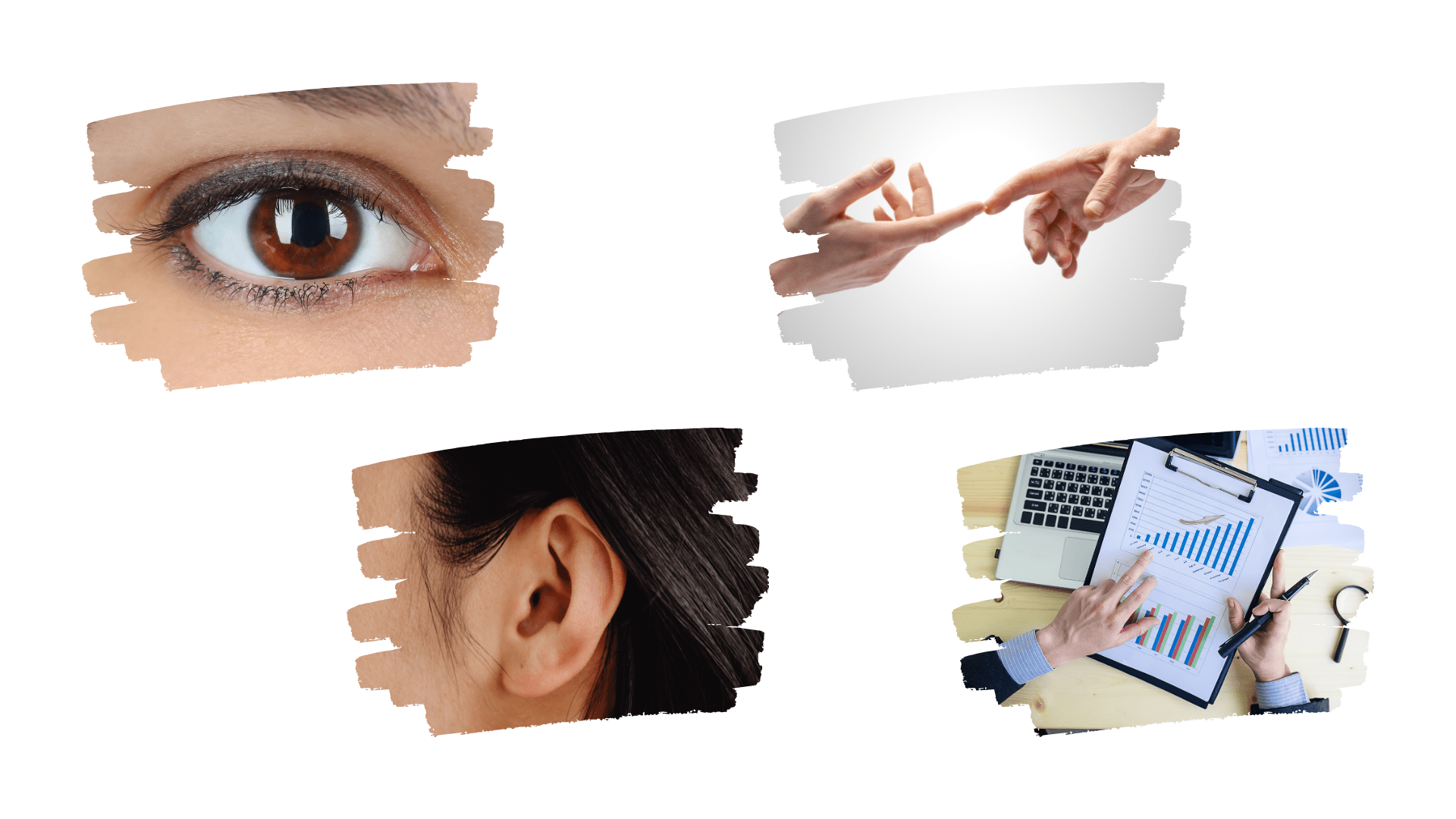
Most of us have a dominant representational style, though, in reality, they´re all present in us in varying proportions. Ideally, we want to work on all the different styles so that they´re well-balanced, and we have the ability to choose which one to use depending on the situation, as each style is particularly useful in certain scenarios.
Each representational system can be recognized by the use of certain words and expressions, in addition to coming across through a person´s gestures, skills and behaviours. Let´s see them one by one.
Visual
- Think and speak in images
- Pay more attention to visual details, faces...
- High level of energy, always doing something
- Value image, dress smartly, want to look good
- Usually keep their house/workspace tidy
- Speak quickly, loudly and clearly
- Think quickly, learn quickly, also forget quickly
- Good at getting the big picture of a situation
- Upright posture, looking directly at the other person
- Often use their hands to express their ideas
- Keep some distance from the other person
- May get angry but don't hold a grudge
- Sample expressions: in plain sight, it looks good, we´ll see...
Kinaesthetic
- Register their experience of the world through their body and their feelings, and that's how they remember
- Relaxed, easygoing, very sensitive
- Dress comfortably, not interested in fashion
- Move slowly without rushing
- Submissive posture, keeping the gaze low
- Speak slowly, softly and quietly
- Learn slowly, through experience
- Once learned, they don't easily forget
- Seek to be close to others, contact, touching
- Usually fun to be with, hate conflict
- Can hold a grudge and seek revenge
- Sample expressions: a heated discussion, between a rock and a hard place...
Auditory
- Use sounds to create experiences
- Pay more attention to auditory details, what others say and in what tone, and that's how they remember
- Relaxed level of energy
- Dress comfortably, don´t care what to wear
- Tendency to look down
- Not looking when listening - need to lend an ear
- Annoyed by loud and screeching noises
- Struggle when there´s a lot of background noise, unable to filter it out; they hear everything
- Auditory and digital are often confused
- <1% of the population is primarily auditory
- Sample expressions: it rings a bell, sounds good, call for attention...
Digital
- Have a need to make sense of the world, to figure things out, to understand
- Think in a very structured and logical way
- Show very little emotion, like to think things through
- Learn by working things out in their mind
- Memorize steps, procedures, sequences.
- Value precision, choose words very carefully
- Make decisions based on logic, facts and figures
- Spend a fair amount of time talking to themselves
- Adopt a sideways posture, keeping some distance
- Prefer not to look directly; quickly look away
- Speak in a monotonous and repetitive tone
- Sample expressions: it makes sense; step 1, step 2, step 3...
Interesting, right? It's almost as if each one of these styles is a different language that we speak without realizing, and when we find people who perceive things and express themselves in a way that's different to ours, that's when misunderstandings happen. That's why it's so helpful to know what they are and how to use them, so that we can be flexible and speak the other person's preferred language at any given moment.
What about you? Which representational system(s) do you identify with the most? And the least?
 English (UK)
  Español