(This is the last article in a ten part series, you can see them all under the category called ReprogramYourLife).
I hope the introduction to "Reprograma tu vida» y las ocho claves que hemos visto en las últimas semanas te hayan parecido interesantes. Y ahora que ya tienes toda esta información, it´s time to get started!
Because the thing is, accumulating knowledge without putting it into practice doesn't really help; it's only by taking action that you can achieve real change.
So, where would you like to start? I invite you to choose one of the eight tips and commit to practice an action related to it during a period of time, for example, 21 days:
Choose just one thing, and make it relatively small instead of trying to do it all at once. Any new habit requires effort until it becomes automated.
Write down your commitment – Fill in and print out the form on the next page (or make your own version using a paper sheet), and put it in a visible place so you can remember it daily.
Tell somebody! Very often, it helps to have to report your progress to someone else.
Don't get discouraged if, for whatever reason, you skip a day. But make sure it's only one; don't let yourself skip two days.
Think about what your reward will be after the 21 days, and enjoy it!
(This article is a follow-up from the ones published in previous weeks, episodes 0, 1, 2, 34, 5, 6 and 7, and the last episode will be published next week)
And we finally arrive at the eighth and last tip in "reprogram your life"; thanks for reading this far 🙂
As we have seen over the last few weeks, there are plenty of similarities between how our mind works and how a mobile phone works, or a computer.
This mobile phone metaphor can be really useful for us to understand and assimilate concepts coming from various disciplines (neuroscience, mindfulness, neuro-linguistic programming...), and also to apply them in practice, as part of our daily life, tweaking our habits in such a way that they actually help us to achieve our goals, improve our vital energy, become more efficient, enhance our communication skills, and ultimately, understand ourselves and others better.
But I would also like to take this opportunity to remind you that this is nothing more than a metaphor, a comparison, and that it can only go so far, because mobile phones and computers are not people; they're just machines. They are very complex and sophisticated, that's true, very smart in their own way, but they're only machines at the end of the day.
And humans are not machines; we are so much more.. You are so much more..
We humans have the capacity to live, create, and feel. The ability to connect with other human beings, with nature, with the deep wisdom of the Universe. To laugh, cry, share, imagine and learn, enjoy the present moment and visualize the future we want for ourselves.
There are certain questions that a machine will never be able to answer... I invite you to reflect on some of them and find your own answers:
What excites you and motivates you most in life?
What's most important to you? What do you value most?
What do you want your contribution to this world to be?
What's that dream you would love to be able to make come true?
(This article is a follow-up from the ones published in previous weeks, episodes 0, 1, 2, 34, 5 and 6, and more episodes will be published in the upcoming weeks)
Throughout the day, our phone sends us notifications about multiple things, displaying alerts and reminders in the form of text messages. Sometimes we can choose to enable or disable certain notifications, for example, from email services or social media platforms, but others are unavoidable as they are related to the device itself, like when the battery is about to run out, or the Wi-Fi connection is lost; also, once every few months, it tells us that the operating system needs to be updated.
The human body also has an inbuilt notifications system that's highly effective and sophisticated: the emotions..
Emotions are produced as a reaction to a stimulus, which can be real, imagined or remembered.
They have a physiological component: our body gets activated in a particular way that's different for each emotion.
They also have a cognitive component: our brain interprets the signals it receives from the body in order to make sense of the experience.
Some emotions are learned or have a cultural component, but a handful of them have been recognized as universal: those emotions are shared by all human beings, and all of us can identify the facial expressions that go with them.
Each emotion brings us a message; it comes to tell us something about what's happening at a particular moment, and if we know how to listen, that message can give us very valuable information.
Emotions can be really intense, but their duration is actually short, approximately ninety seconds. The problem comes when we get "stuck" in an emotion, going over it again and again in our heads, because those repetitive thoughts keep re-triggering the emotion in a vicious circle. That's how we generate a specific mood or state of mind, which is less intense than an emotion but lasts longer and has less defined beginning and end moments.
So, what can we do to avoid getting stuck? We can embrace that emotion as it appears, and allow ourselves to feel it. We can let it pass right through us, staying present, without trying to avoid it or run away from it. That will allow us to acknowledge it, recognize it, give it a name, and listen to the message it brings. Because once the message has been delivered, the emotion has accomplished its mission and can leave. And we can let it go, using the information received to make a decision and act accordingly.
Joy
What is it telling me? – Something pleasant has happened, or I have achieved a goal.
What for? – To enjoy it!
Also... – My smiling face conveys friendliness: "I'm not a threat to you".
Surprise
What is it telling me? – There's something new, sudden and unexpected.
What for? – To focus my attention.
Also... – My eyes open wide so that I can investigate that new thing that has just appeared.
Fear
What is it telling me? – There's a danger that threatens my safety.
What for? – To avoid or mitigate the damage.
Also... – My senses sharpen, and my body prepares to protect me from danger.
Anger
What is it telling me? – There's an obstacle in my way, or a boundary that's important to me has been trespassed.
What for? – To remove the obstacle or defend my boundaries.
Also... – My body prepares to attack.
Sadness
What is it telling me? – I lost something valuable or have an unmet need.
What for? – To look for help or take some time to recover.
Also... – My emotional pain can also trigger some physical pain.
Disgust
What is it telling me? – There's a potentially toxic substance or situation.
What for? – To avoid contamination.
Also... – Feeling repugnance makes me avoid things that are not good for me.
Which of these notifications do you receive more often? And what do you do when you notice them? If you´re interested in this topic, here´s another article about emotions that I wrote some time ago.
(This article is a follow-up from the ones published in previous weeks, episodes 0, 1, 2, 34 and 5, and more episodes will be published in the upcoming weeks)
A tremendous advantage of mobile phones is that they can be used for a virtually endless amount of things, as long as the appropriate application is installed. Typically, new phones come with a set of basic apps already installed, and in order to add more, all we have to do is search in the "app store", find the one we need and press a button to install it, often for a symbolic price, or even for free.
Even during those times when it appears to be idle, while it's switched on, the phone is always "doing something". At a minimum, it stays vigilant in case there's an incoming call or message. Then on top of that, it may be running other applications "in the background", for example, to count your steps, calculate your physical location, or play music for you, if you feel like it.
Similarly, our mind is always "doing something"; it's always thinking. And if we don't consciously give it something to think about, it will find its own thing, often in ways that don't help us at all.
So then, what "apps" could we "install" in our mind that will help us instead of harming us? Here are a couple of suggestions.
Positive thinking and thankfulness
Our brain unconsciously searches for more of whatever it is we pay attention to. Therefore, if we focus on being thankful and appreciating the positive things already in our life, our brain will start finding more of those for us, and as a result, we'll perceive more and more things we like, and we'll feel better and better.
Systematic use of negatives
The same applies in the opposite direction; that is, if we focus on negative things, we’ll start finding more and more of those. But what if there was a trick to take the things we don’t like so much and present them to our brain more positively? According to neuro-linguistic programming, that trick exists.
For example, if I feel very tired on a particular day, I can choose to say: “I’m exhausted”. The word “exhausted” has a certain effect on my mind and body, so much so that just thinking about it makes me physically tired. In contrast, if I say: “I don’t have a lot of energy”, the meaning is very similar, but the effect of the words on me is completely different. By expressing it this way, chances are I’ll feel a little more energetic, instead of tiring myself even more, and that may help me to carry on with my day until I can finally go home and rest.
(This article is a follow-up from the ones published in previous weeks, episodes 0, 1, 2, 3 and 4, and more episodes will be published in the upcoming weeks)
Have you ever seen the source code written for a computer program or mobile app? There are many different IT programming languages, which are basically ways of giving machines instructions in a format they can understand. Each program or application is a list of step-by-step instructions showing the device what to do to accomplish a particular task.And many of those steps are related to the functions of processing information coming from the external world (either the internet or the user, who interacts with the system through buttons, the keyboard, the microphone...), storing that information in memory, and representing it through the screen, the speakers, etc.
We could argue that we humans have something similar to instructions stored in our brains, in the shape of filters with which we process the perceptions of reality that we receive from the outer world through our senses. Our conscious mind receives millions and millions of information bits per second, and it wouldn't be able to absorb such a relentless flow of incoming data as is, so our brain builds filters that automatically select and simplify the most relevant parts of the information, which allows us to make sense of the world around us and interact appropriately with it.
These filters are essential for our survival and tremendously helpful in general, but they can also very often play against us if we are unaware of them. This is because our mind is made to work with patterns, and while it's in the process of simplifying all the information coming from the senses, it builds patterns that generalize, distort and omit parts of our perception of reality..
And how does it do that? Through language. The "programming language" we humans use is literally our language, as in our words. It's what we use to communicate with each other and convey ideas, but also internally to think and make sense of the concepts in our minds.
The neuro-linguistic programming identifies those generalization, distortion and omission patterns as part of what it calls the meta-model. The meta-model explains how each pattern can create ambiguities that hinder our capacity to understand our current situation, limiting our options when dealing with it.
These meta-model patterns are present in our everyday life; As we start paying attention to our internal and external dialogue, we'll discover that we use them very frequently. And it's usually OK for our language to contain a certain level of ambiguity; it's our natural way of communicating, and it would be exhausting if we had to be precise and exact at every single moment. But there are occasions when being more precise can be really beneficial, like when we're ruminating about something, looking for a solution to a problem or trying to overcome a challenge.
Let me give you an extreme example: if I think and say: "my life is a disaster", that sentence is so vague that it gives me a sense of overwhelm, so I end up feeling that I can't do anything to fix the issue, I don't even know where to start. In contrast, if I think and say: "I feel sad because I just had an argument with my partner", that sentence is a lot more specific, more tangible, and it clearly expresses what the problem is, which makes it a lot easier to try and find ways to tackle it.
Now, let's look at a few examples of generalizations, distortions and omissions, some tips on how to recognize them, and what to do when we find one. The key point is always to try and minimize ambiguity as much as possible, "filling in the blanks" with explicit words instead of leaving room for interpretation; this way we get a lot more clarity on the situation.
Generalizations
Symptom – Using absolute words: everything, nothing, always, never...
What to do? – Question if that general rule applies in all cases.
Examples:
I need to continue in this job.
It's impossible to get rich quickly.
They're all against me.
I can't change.
I'm always last.
I never get to do things my way..
From this group, the easiest ones to catch are "always" and "never" - you can ask my daughters, I´m sure they´ll agree 🙂
Distortions
Symptom – Arriving to conclusions by taking things for granted.
What to do? – Shed light onto whatever is being assumed.
Examples:
Your dad doesn't understand me
You didn't call yesterday, you don't love me...
That woman's voice gives me headache
Which one are you going to clean first, the bathroom or the kitchen?
This last formula is a powerful one to use on purpose, for example, to give your kids options but within the parameters that you decide (what kind of fruit are you going to eat, apple or banana?), or even to motivate ourselves – there´s no option not to clean!
Omissions
Symptom – Missing information or using abstract words.
What to do? – Specify what's missing, and make it concrete.
Examples:
There's no solution for this.
His attitude annoys me.
You need to drink eight glasses of water every day
People gossip a lot.
You can do it better.
I have a problem.
The idea here is to keep asking so that whatever was left unsaid finally comes up. What exactly? According to whom? Better than what?
What do you think about all these patterns? Are they clear to you? Try to "catch yourself" using them this week, you'll be surprised to see how often they appear...
(This article is a follow-up from the ones published in previous weeks, episodes 0, 1, 2 and 3, y en las próximas semanas se irán publicando más episodios)
Have you ever stopped to count the number of applications running simultaneously on your phone? Mobile phones, like all computers, are designed to be able to run multiple programs in parallel; some of them are very easy to identify, like the different apps we have installed over time and we frequently use, and then there are others, like the operating system processes, that we don't usually even notice but that are indispensable for the device to work.
We as human beings work similarly: our conscious mind performs certain voluntary tasks, the ones we choose to do, which would be the equivalent of our phone's apps. But in addition to that and at the same time, our unconscious mind is performing a variety of other tasks in an automated and completely involuntary way, without any thought intervention: it's constantly receiving and processing information coming from the external world as well as the body's organs, and it regulates all our bodily functions in order to better adapt to the environment and our current situation.
Now, it's worth noting a fundamental difference in how computers work compared to humans: the human brain can only focus consciously on one thing at a time. We can fool ourselves into thinking we're doing several things at the same time (what's commonly known as multitasking), but in reality, what we're doing in those instances is just changing context very quickly, very often. And each of those changes requires an extra effort to get back to focus on the task again.
Multitasking = continuous partial attention
So, similarly to those times when our phone is really slow because it´s overloaded with too many apps running simultaneously, and as soon as we close a few of them, performance improves, the more we can close other applications in our mind and focus only on the task at hand, the more efficient and productive we will become, and the less mental tiredness we will suffer.
In fact, that´s the basis for all mindfulness techniques and exercises, learning to focus on the here and now, on the present moment, and being able to direct our attention consciously..
This also gives us an additional advantage, something that´s badly needed in this modern world: the ability to focus more deeply on a particular task, which is something we can never achieve through multitasking.Once we recover our ability for deep focus, like when we were kids and could play for hours, it´s much easier to let creativity and ideas flow more freely.
(This article is a follow-up from the ones published in previous weeks, episodes 0, 1 and 2, and more episodes will be published in the upcoming weeks)
Nowadays, mobile phones can stay switched on for many days in a row. But every now and then, they need to be restarted, and as part of the restart process, they perform a series of tasks and updates that allow them to continue to work optimally.
Luckily, as humans, we also get to reset our system once daily, and we can take advantage of those special moments at the beginning and the end of our day to get back to our centre, check in with ourselves and evaluate our goals and priorities, so that we can live every day from a place of intention, making our own decisions, instead of simply reacting to whatever happens and getting carried away by the day's events.
When getting up
What can you include in your morning routine to help you start the day on a positive note? It doesn't have to be fancy; the most important thing is that it works for you, because that's the time you're devoting to yourself, to your own personal development.
Here are a few suggestions:
Breathing consciously
Planning/visualizing your day
Reading an inspiring book
Writing down your thoughts
Repeating positive affirmations
Being thankful for what you already have
Meditating
Doing some yoga or stretching
Going out for a walk or run, playing a sport…
Preparing a special breakfast for yourself
Before going to bed
You can use these same ideas for your bedtime routine, or if you prefer something simpler, I suggest writing down four things in a notepad using the Spanish acronym AMOR (LOVE):
A for Agradecimiento – THANKFULNESS: What do I feel thankful for today?
M for Mejorable – IMPROVABLE: What did I aim to do that I didn't achieve? What would I do differently?
O for Orgulloso - PROUD: What was I able to achieve today? What obstacles did I overcome?
R for Reflexión – REFLECTION: What surprises did I find along the way? What did I learn?
What do you think about these ideas to reset yourself each day? What works best for you?
Just as computers and mobile phones are configured with factory settings that allow them to perform certain functions more efficiently, we, as humans, come with specific characteristics and natural tendencies, que hacen que unas tareas se nos den mejor que otras. Cuanto mejor conozcamos esas «prestaciones», las nuestras y las de los demás, mejor podremos aprovecharlas para entendernos y comunicarnos mejor.
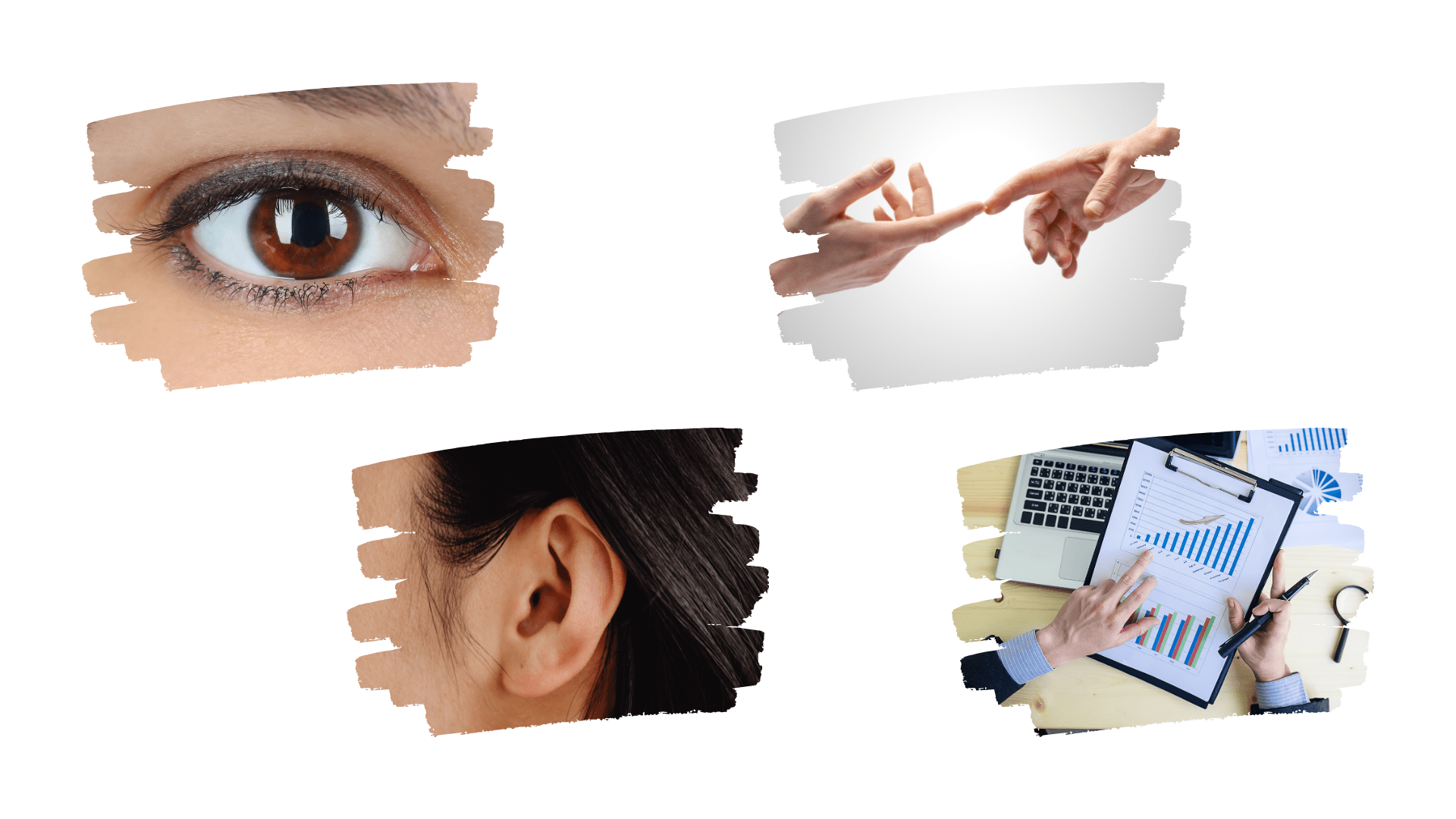
From before birth and throughout life, we human beings perceive reality through our five senses: sight, hearing, smell, taste and touch. Most of us naturally rely more heavily on certain senses and less on others, which determines our understanding of the world and influences our behaviour and means of self-expression.
Based on all this, the field of neuro-linguistic programming defines several different ways to represent reality: they´re the so-called representational systems: visual, kinaesthetic, auditory and digital.
Most of us have a dominant representational style, though, in reality, they´re all present in us in varying proportions. Ideally, we want to work on all the different styles so that they´re well-balanced, and we have the ability to choose which one to use depending on the situation, as each style is particularly useful in certain scenarios.
Each representational system can be recognized by the use of certain words and expressions, in addition to coming across through a person´s gestures, skills and behaviours. Let´s see them one by one.
Visual
Think and speak in images
Pay more attention to visual details, faces...
High level of energy, always doing something
Value image, dress smartly, want to look good
Usually keep their house/workspace tidy
Speak quickly, loudly and clearly
Think quickly, learn quickly, also forget quickly
Good at getting the big picture of a situation
Upright posture, looking directly at the other person
Often use their hands to express their ideas
Keep some distance from the other person
May get angry but don't hold a grudge
Sample expressions: in plain sight, it looks good, we´ll see...
Kinaesthetic
Register their experience of the world through their body and their feelings, and that's how they remember
Relaxed, easygoing, very sensitive
Dress comfortably, not interested in fashion
Move slowly without rushing
Submissive posture, keeping the gaze low
Speak slowly, softly and quietly
Learn slowly, through experience
Once learned, they don't easily forget
Seek to be close to others, contact, touching
Usually fun to be with, hate conflict
Can hold a grudge and seek revenge
Sample expressions: a heated discussion, between a rock and a hard place...
Auditory
Use sounds to create experiences
Pay more attention to auditory details, what others say and in what tone, and that's how they remember
Relaxed level of energy
Dress comfortably, don´t care what to wear
Tendency to look down
Not looking when listening - need to lend an ear
Annoyed by loud and screeching noises
Struggle when there´s a lot of background noise, unable to filter it out; they hear everything
Auditory and digital are often confused
<1% of the population is primarily auditory
Sample expressions: it rings a bell, sounds good, call for attention...
Digital
Have a need to make sense of the world, to figure things out, to understand
Think in a very structured and logical way
Show very little emotion, like to think things through
Learn by working things out in their mind
Memorize steps, procedures, sequences.
Value precision, choose words very carefully
Make decisions based on logic, facts and figures
Spend a fair amount of time talking to themselves
Adopt a sideways posture, keeping some distance
Prefer not to look directly; quickly look away
Speak in a monotonous and repetitive tone
Sample expressions: it makes sense; step 1, step 2, step 3...
Interesting, right? It's almost as if each one of these styles is a different language that we speak without realizing, and when we find people who perceive things and express themselves in a way that's different to ours, that's when misunderstandings happen. That's why it's so helpful to know what they are and how to use them, so that we can be flexible and speak the other person's preferred language at any given moment.
What about you? Which representational system(s) do you identify with the most? And the least?
I'm sure we have all experienced this at some point: no matter how top-notch and ultramodern our phone is, it becomes useless if we forget to charge its battery. A mobile phone with little battery has more limited functionality, and if it gets to the point of running out of power, it just stops working.
Similarly, we as humans also need energy to be able to function properly, even if the kind of energy we use and the way we "recharge our batteries" are quite different.
This may seem silly, but in reality, it's not. It is surprising how often we neglect our most basic needs, probably because we don't realize how that carelessness is robbing us of our energy and interfering with our performance. And even though we don't have an automatic gauge that tells us the percentage of battery left, our body does send us signals to let us know what it needs, but we can only notice those signals if we are paying attention.
So, before we proceed to start the reprogramming work, I propose that we go through the essential care required by your device (that is, your body), with special emphasis on your central processing unit (your brain), and make the necessary adjustments so that they can maintain an optimal level of energy.
Rest
Just as a mobile phone needs to be charged every now and then, a person needs to sleep and rest every dayfor a variety of reasons.
Leaving aside the general fact that our body needs to sleep for several hours every night to recover from the day and regain strength, sleep time is especially important for our brain. This is because some of the processes that happen during sleep help us to assimilate what we learned during the day, while others perform cleaning and brain cell regeneration tasks. We could say that our brain takes advantage of the quiet time and uses it to perform maintenance tasks, just like old computers used to perform hard disk "defragmentation".
But to allow this to happen, we must achieve deep sleep, high-quality sleep. There´s no point in sleeping very little one night and then "making up for it" later on; that´s not how it works... The best thing we can do is give rest the priority it deserves and establish routines that favour deep restorative sleep, remembering that resting is not a waste of time but rather the opposite: it´s fundamental for our health.
Diet
Our body also needs to receive nutrients from the external world, to transform them and produce its own energy:
Foods: a healthy and varied diet, as natural as possible, nurtures us and provides us with plenty of energy while eating carelessly can bring about all kinds of health problems, some of them more obvious and immediate than others.
Water: there´s a high percentage of water in our body´s composition; some of that water is lost over time and needs to be restored. Dehydration is not always easy to detect, and it can affect us in a big way, both physically and emotionally.
Air: oxygen is also a vital element for our body to function. By breathing consciously more often, we achieve better oxygenation of our cells and gain the ability to calm down and connect with ourselves at a deeper level.
All this applies in general to our body and in particular to our brain, which is the most advanced and complex of all our organs, and has very specific needs. Even though the brain accounts for just 2% of a person´s body weight, it consumes approximately 20% of the available glucose, about 50% of the oxygen, and big amounts of water (in fact, the brain is 80% water). So, to help it to perform at its best, let´s ensure it has everything it needs.
Exercise
Human beings are designed to move around, not to sit down all day. There are many benefits of exercising regularly:
Physically – exercising gives us energy and vitality, strengthens our immune system and helps us to stay fit and rest better.
Mentally – it´s been proven that physical exercise positively impacts brain activity, for example, in areas related to learning, memory, cognitive functions and decision-making.
Emotionally – daily exercise is our best ally to combat anxiety and depression, minimize stress and generally improve our mood, as it releases endorphins, which generate a sense of well-being, as well as other hormones like dopamine, serotonin and noradrenaline, all of which help with regulating our emotions.
Choose a type of exercise you like and feel motivated to do; that way, it will be easier for you to keep it as a habit: it could be your favourite sport, swimming, running, dancing, doing yoga... The important thing is to get moving and to do it often.
Connection
Nowadays, there´s not much point in having a phone or computer without an internet connection, right? We can do some things offline, but not many, only a handful, and the list is getting shorter.
We as humans also need connection: we are social beings by nature and are programmed to connect with others. Our brain has adapted to live in society, cooperate with others, and empathize with their emotions.
Sometimes we forget the importance of staying in contact with our loved ones, sharing, doing our bit for society, and ultimately, feeling part of something bigger than ourselves. That connection with others, that sense of belonging to a family, a group of friends or a community, gives us a solid foundation from which we can face the challenges that life puts in front of us.
But equally important, or even more, is knowing how to also connect with ourselves, set aside distractions and truly listen to our inner selves, get to know us deeply, and discover who we are. It´s worth investing in becoming our own best friend, as we are the only person we know who will be our companion for the rest of our lives.
(And that's tip number 1, more to come next week...)
Today we´re starting a series of articles where I´ll be showing you the content of my ebook first steps to reprogram your life, linking IT and computer science concepts with the world of personal development (typical me!). I hope you like it and find it helpful.
Very often in our life, we want to make a change, achieve a goal, make a dream come true... But we don't know where to start.
The truth is, it all begins in our minds. The human mind is an amazing artifact, a lot more powerful than any computer ever manufactured, and it can generate endless possibilities for our life. But for those possibilities to go in the direction that we want, we need to learn to make our minds work in our favour and not against us, which is what it unconsciously does sometimes.
Through these pages, I'm inviting you, by using a mobile phone as a metaphor, to explore how to reprogram your mind, and your life, to get closer to the results you want to obtain. Please, feel free to question any of the ideas you read here, try out the suggestions that resonate with you, and give yourself permission to not pay attention to the ones you don't find appropriate. At the end of the day, it's all about being curious and keeping an open mind, and experimenting in order to find what works best for each of us.
Enjoy the adventure! And if you would like to share your experience with me, feel free to email me at binarybea@binarywords.com, and I'll be delighted to read you.
Would you like to get as much out of your life as you get out of your phone?
Do you ever feel that you wouldn't be able to live without your phone? Isn't it amazing the amount of things we do on our phones every day? So many different apps that make our lives easier, from sending messages to paying at the supermarket, finding our way without getting lost, watching our favourite series...
A mobile phone is a wonderful tool, a really easy-to-use superpowerful computer compressed in a pocket-size format. And best of all, we can configure it in whichever way we like: we can set up a personalized background screen, install and uninstall apps as we see fit... We can greatly benefit from having a mobile phone, provided that we know how to use it correctly.
If only we had a similar thing for real life, right? Having the ability to press a button and make things happen magically, exactly how we want them to happen... Because, let's be honest, the benefits of mobile phones are great, but we all know that the best things in life happen outside the screen..
It is outside the screen where we really get to live, where we are faced with the joys, surprises and challenges that life puts in front of us. Where we want to change the things we don't like or the things we know could be a lot better than they are right now.
Wouldn't it be great to be able to install an app in our head to be able to make all those changes we want, to be able to configure our life in our own way?
Interestingly, the human mind is a lot more similar to a mobile phone or a computer than we may think: it's also "programmed" to work in a specific way, and those "programs" it uses (language and behaviour patterns, either inherited or learned) can be changed to enable whatever changes we want in our life.
OK, and how can we do that? Well, it may not be as simple and quick as pressing a button, but once you learn how to do it and start putting it into practice, you may be surprised by the results. You will need to be patient, though, and give it time and attention, because those old patterns have probably been installed there for a really long time, and initially, our brain finds it much more difficult to "execute" new programs than old ones.
Are you ready to start the adventure of reprogramming your life? Over the next few weeks, I'll give you eight tips to help you to take your first steps; let's go!




 English (UK)
  Español