Career paths (II)

As I was telling you in my previous post, last week I had the opportunity to deliver a talk about my professional career to a class of secondary school kids.

I had a hard time preparing the presentation, partly because I generally find it difficult to talk about myself (and I don't like pointing at myself as an example of anything), and partly because I didn't have a clear idea of how to express what I wanted to convey. At this stage, I know for a fact that storytelling is not my thing, so I had to find another way.

Luckily, a couple of days before the talk I had a chat with a friend (thanks Quique!) who really helped me to put myself in those teenagers' shoes; we spoke about how at that age, typically only a few teens have a good idea of what they would like to study in college, or what they'd like to do for a living; most often, they don't have a clue. If on top of that we add the ever-growing amount of available options, and the rate at which the workplace landscape keeps changing, we end up with a level of uncertainty that's a lot higher than for previous generations. And that's overwhelming.

All this gave me an idea, a metaphor I could use to explain what I wanted to convey to them...

I remembered Dora the Explorer.
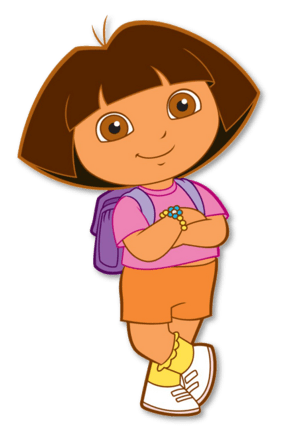
Dora the Explorer cartoon character, standing with her arms crossed and smiling

If you've ever watched an episode of Dora, you'll remember that she always has a mission to accomplish, a goal to achieve, and that she keeps finding challenges and difficulties along the way, but in the end she always gets to achieve the goal (and to celebrate!)

So, what does Dora have (apart from her friend Boots) that helps her to overcome those challenges and difficulties?

First of all, a map.

Map used to show Dora the way at the beginning of every episode, almost always with three places she had to get through before arriving at her destination:
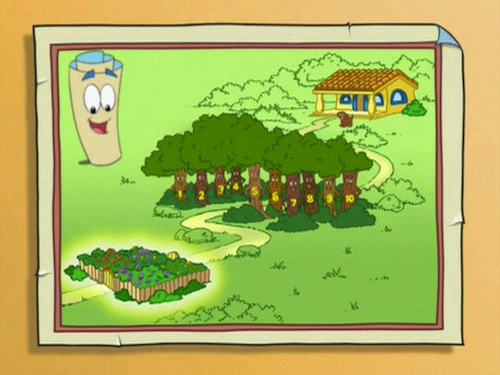
But the thing is, Dora's map was always right, it knew exactly what she would find along the path... Obviously, in real life we know that "the map" (that is, our plan) is just for orientation purposes, and, following the reasoning from last week's post, something like this is most likely to happen:

So, you know, as I see it, it's great to have a map, a plan, especially at the beginning. It can help us, it can point us in the right direction, but it's not going to solve all our problems, so if we don't have a plan, it's not the end of the world either, the way will reveal itself in due course.

First message: it's OK if you don't have a plan, it's going to change anyway.

But then, what can we do to prepare?

This is where we get to the second object Dora always carried with her, which to me is a lot more important and a lot more interesting than the map. Do you remember what it was?

A backpack.

A backpack full of all kinds of tools. And every time a challenge appeared, Dora opened her backpack and took out the perfect tool for the occasion, the one that would allow her to solve the problem.
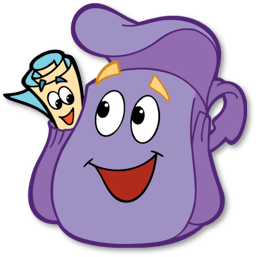
Cartoon - Backpack and Map from Dora the Explorer

Second message: we may not know the exact path we will need to walk, but in the meantime we can get our backpacks ready, filling them with tools that will be useful for work an well as for our personal life and relationships.

Those "tools" can be:

  • Natural talents and abilities that we already have, and that we can continue to work on and improve.
  • Things we learn in a formal environment (primary and secondary school, college, workplace, etc.), and I'm not referring only to what's in the books (though that's important as well), but also many other skills we learn while we go through these experiences.
  • Things we learn in less formal environments, and that we seek for ourselves: extra curricular activities, interests, hobbies...

In summary: everything we learn in the different environments we interact with gets incorporated into our backpack. And out of all those tools, the most useful ones are the ones called "transferrable skills", because they can be applied to any professional or personal environment. Here are a few examples of the most typical ones:

  • Communication and presentation skills
  • Organizational skills
  • Quality focus and attention to detail
  • Adaptability to change
  • Collaboration and teamwork

And my favourite, the best one in my opinion, because to helps to develop all the others: self-awareness and self-management.

What are your thoughts on this backpack idea? What tools do you have in yours? And which ones would you like to acquire?

Career paths (I)

One of the many things I love about the company I work for is the bunch of volunteering opportunities available to us. For a few years now I've been collaborating with Junior Achievement, an international institution who establishes links between students in primary and post-primary education and professionals from the corporate world.

The idea is for us volunteers to visit primary and secondary schools and deliver training sessions and other events to the kids, not only to bring them new knowledge (though that's part of it, especially in areas like economics, business, science, technology, engineering and maths), but mainly to be a role model for them; that way, they can see that staying in the education system pays off, as it gives them more chances to find a good job.

In previous years, I've done training sessions on science, technology and the like, but my task for this week was something very different: delivering a talk about my professional career to a secondary school class, in order to inspire them at this crucial moment when they're starting to decide what to do with their life.

My professional career.

Twenty years, more or less, since I started to work.

To be honest, at the beginning I didn't have a clear idea of what I could say that they would find inspiring, or at least somewhat helpful... How could I become a useful example for them? What did I learn in all these years that's worth telling? What would have helped me to hear when I was their age? I slowly started to dig deeper and deeper, and a common thread started emerging; an idea, a message that I would also like to share with you.

Diagram displaying a straight arrow from "start" to "end" with the label "How life is supposed to go", followed by another arrow full of twists, turns and loops between "start" and "end", and the label "How life actually goes"

This diagram is a great illustration of "how life is supposed to go" (a perfect straight line from the starting point to the end) versus "how life actually goes" (an extremely whacky and bendy line, full of twists, turns and even loops, from the starting point to the end).

This is as true for professional careers as it is for anything else in life: I realized this first hand as I was preparing my presentation, and I noticed I had drawn my trajectory as a perfect arrow from left to right, with significant milestones at regular intervals, when in reality there were a good few twists and turns, many of them unexpected, coming from outside, but also a few that I decided to initiate myself, from the inside.

Luckily, my presentation also had to include a section on "successes and failures", so that's where I took the opportunity to explain a few of those twists and turns along the years, which, depending on how you look at them, can be considered failures, in the sense that things didn't turn out how I expected them to.

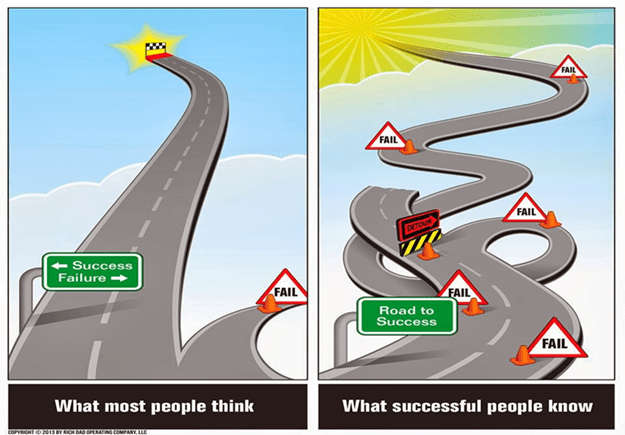
And I said "depending on how you look at them" because this black and white thinking that states that things are either a success or a failure doesn't seem accurate to me; I prefer looking at it this way:

Two drawings: on the left hand side, over the label "What people think", a road forks into "Success" as the wide shiny road straight ahead and "Failure" as a narrow winding road to the side, blocked by an orange cone and a FAIL sign. On the right hand side, the "road to success" combines a few different road branches that twist, loop and end in FAIL with one that continues ahead, with another couple of FAILs along the way, and the shiny success at the end

This other diagram shows us "what most people think", which is that success and failure are mutually exclusive, and that failure derails you from the path of success, versus "what successful people know", which is that what we call failure is nothing more than feedback indicating which way not to go, so that we can try different routes and end up finding the right way, the way of success.

And this is something I would have greatly benefited from if I had heard it twenty years ago: that it's OK to make mistakes (at work and in life), that getting it wrong every now and then is completely normal, and it's even necessary, because it allows us to learn and make progress in life, figuring out our own path.

How about you? What do you think about these two diagrams?

  • If you've been in the workforce for a few years already, are these hypotheses true in your case as well? What would be the shape of your professional career, if you were to draw it? What twists, turns or blockers have you found along the way?
  • And if you've only recently joined the workforce, or haven't joined yet, how does it feel when you hear your professional career will probably be this chaotic? What do you think could help you to prepare a little better?

Next week I'll tell you something else that came to my mind when preparing for the talk: a way to think about your professional career that I hope will provide you with some fresh ideas and practical tools.

Stoic wisdom

According to the experts, one of the most effective things we can do to stay mentally and emotionally healthy is to keep learning for life learning new things that we enjoy and find interesting not only provides us with new knowledge, but also gives us motivation and flexibility, as well as opening our minds.

I wouldn´t be able to tell you when I first got interested in topics related to personal growth. I think part of it started when I moved from Spain to Ireland, as I was beginning a new life in many ways. Fast forward to the last few years, especially since the pandemic hit, and my interest in this field, together with the variety of specific topics and the time and attention I dedicate to them, have exponentially grown. But deep down, I believe this itch started way, way back.

For example, I remember really enjoying the subject of philosophy when we had it in school (3rd year of BUP, for whoever knows what that means); I even read a novel about the history of philosophy that our teacher recommended: Sophie´s world, and I also loved it.

Ruins of an ancient Greek temple against a blue sky with clouds

Many years later, I´ve bumped into the world of philosophy again, this time through a course on stoicism and enneagram (which I totally recommend, as every other course from Autognosis) that I´ve just finished this week.

To be honest, I´ve really enjoyed it, and the best part is that it´s a very practical kind of philosophy: a series of principles that we can apply to our day-to-day life, to be happier and suffer less. Nowadays we may think of philosophy as this complicated theoretical thing you can talk about (philosophize!) for ever, but so far removed from real day-to-day life that it doesn´t help at all, so nothing changes. But the ancient Greeks and Romans saw it differently: for them, philosophy was much more tangible, it was their way to get guidance in life. Back then, philosophers were the equivalent to today´s therapists and coaches.

There´s a lot we can learn from stoicism´s teachings and reflections, I´ll tell you some of them in blog articles as we go along. For the moment, today I´d like to leave you with a text you may already be familiar with; it´s relatively recent, but it has a lot to do with one of stoicism´s principles, one that resonates especially with me: the dichotomy of control.

The dichotomy of control warns us about the uselessness of spending energy trying to dominate what´s outside of our control, and encourages us to focus on what we can control instead, so that we get less frustrated and also achieve better results. And in that context, the prayer of serenity just fits perfectly:

Lord, grant me the serenity to accept the things I cannot change,
the courage to change the things I can,
and the wisdom to know the difference.

Reinhold Niebuhr

By the way, I just remembered that it was in that same philosophy class from school where I first heard about Socrates and his maieutic, one of the foundations of modern coaching 🙂

Consistency

About two years ago, shortly after starting this re-incarnation of BinaryWords, my friend María gave me a piece of advice: putting together a calendar to plan when to write the blog articles. I thought it was a really good idea, and simplifying it to make it a bit easier for myself, I decided to write a new blog post every week.

Old typewriter keyboard

Two years later, I have to say I´m proud of being able to keep this cadence. Though I do have to confess that, given my tendency to leave certain things until the last moment, my "weekly post" strategy quickly became "Sunday night´s post", reaching the point when there are literally no more hours in the week 🙂

But the strategy served me well, and still does. Not breaking my promise is what motivates me to sit down in front of the keyboard every Sunday, no matter where I am, or whether I feel like writing or not. I´ve written posts from airports, trains, country homes, and even from an inflatable mattress in my friend´s living room. Very often I´ve run into the early hours of the morning, technically getting the publication done on the Monday. But that´s not the point; the point is that the posts have continued to publish.

And I´ve continued to write.

Even when I didn´t feel like it.

Like today, for example.

And this is something that happens in every field: do you think athletes feel like going to their training sessions every day? Even when the weather is bad, when they feel physically unwell, or when they´re demotivated? No way. But they do it regardless, because they know it´s important to be consistent; it´s what allows them to make progress towards their goals.

And when I say athletes, I could say anything really; any activity that we take seriously and want to make progress on requires consistency: painting, writing, exercising, playing an instrument... All of this, of course, requires discipline, but there are also a few tricks that may help us:

  • Make it easy for yourself: set a realistic goal for your activity, book specific time in your calendar for it, and aim to reduce as much as you can the effort required to get started. For example, if you´re planning to go for a run in the morning, the previous evening you can prepare your clothes, place your runners by the door, etc.
  • Don´t think about it: us human beings are specialists at making emotional decisions and then justifying them rationally. If you start overthinking it and bargaining with yourself, you´re almost certain to find reasons not to do the activity. It´s time to do it, and that´s what it is, go for it!
  • Do it, even if it´s just a little bit: the hardest part of all is getting started, so if you find that you´re not motivated enough to complete the full activity, at least commit to doing part of it, like for example, running for five minutes. When time is up, give yourself permission to stop (if you still need it), or to continue, which will probably be a lot easier now that the initial resistance barrier has been broken.

What about you? How good are you at consistency? In which areas of your life do you find it easier to stay consistent, and in which ones it´s more difficult? What motivates you to get started even on days when you don´t feel like it?

Let´s remember the words of Pablo Picasso, referencing the arts in this case, but applicable to any goal or objective in life:

Inspiration exists, but it has to find you working.

Pablo Picasso