As I was telling you in my previous post, last week I had the opportunity to deliver a talk about my professional career to a class of secondary school kids.
I had a hard time preparing the presentation, partly because I generally find it difficult to talk about myself (and I don't like pointing at myself as an example of anything), and partly because I didn't have a clear idea of how to express what I wanted to convey. At this stage, I know for a fact that storytelling is not my thing, so I had to find another way.
Luckily, a couple of days before the talk I had a chat with a friend (thanks Quique!) who really helped me to put myself in those teenagers' shoes; we spoke about how at that age, typically only a few teens have a good idea of what they would like to study in college, or what they'd like to do for a living; most often, they don't have a clue. If on top of that we add the ever-growing amount of available options, and the rate at which the workplace landscape keeps changing, we end up with a level of uncertainty that's a lot higher than for previous generations. And that's overwhelming.
All this gave me an idea, a metaphor I could use to explain what I wanted to convey to them...
I remembered Dora the Explorer.
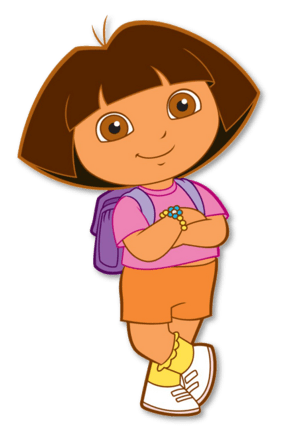
If you've ever watched an episode of Dora, you'll remember that she always has a mission to accomplish, a goal to achieve, and that she keeps finding challenges and difficulties along the way, but in the end she always gets to achieve the goal (and to celebrate!)
So, what does Dora have (apart from her friend Boots) that helps her to overcome those challenges and difficulties?
First of all, a map.
Map used to show Dora the way at the beginning of every episode, almost always with three places she had to get through before arriving at her destination:
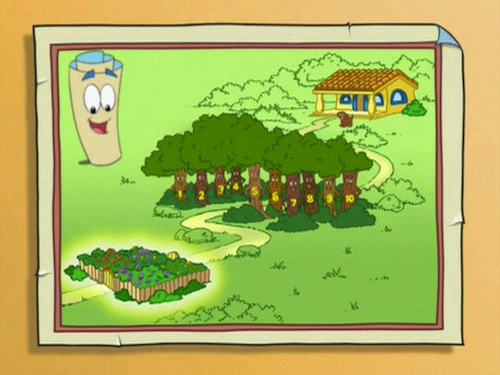
But the thing is, Dora's map was always right, it knew exactly what she would find along the path... Obviously, in real life we know that "the map" (that is, our plan) is just for orientation purposes, and, following the reasoning from last week's post, something like this is most likely to happen:

So, you know, as I see it, it's great to have a map, a plan, especially at the beginning. It can help us, it can point us in the right direction, but it's not going to solve all our problems, so if we don't have a plan, it's not the end of the world either, the way will reveal itself in due course.
First message: it's OK if you don't have a plan, it's going to change anyway.
But then, what can we do to prepare?
This is where we get to the second object Dora always carried with her, which to me is a lot more important and a lot more interesting than the map. Do you remember what it was?
A backpack.
A backpack full of all kinds of tools. And every time a challenge appeared, Dora opened her backpack and took out the perfect tool for the occasion, the one that would allow her to solve the problem.
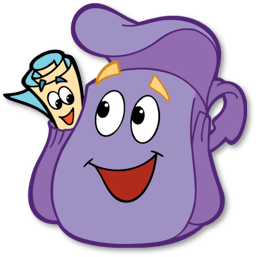
Second message: we may not know the exact path we will need to walk, but in the meantime we can get our backpacks ready, filling them with tools that will be useful for work an well as for our personal life and relationships.
Those "tools" can be:
- Natural talents and abilities that we already have, and that we can continue to work on and improve.
- Things we learn in a formal environment (primary and secondary school, college, workplace, etc.), and I'm not referring only to what's in the books (though that's important as well), but also many other skills we learn while we go through these experiences.
- Things we learn in less formal environments, and that we seek for ourselves: extra curricular activities, interests, hobbies...
In summary: everything we learn in the different environments we interact with gets incorporated into our backpack. And out of all those tools, the most useful ones are the ones called "transferrable skills", because they can be applied to any professional or personal environment. Here are a few examples of the most typical ones:
- Communication and presentation skills
- Organizational skills
- Quality focus and attention to detail
- Adaptability to change
- Collaboration and teamwork
And my favourite, the best one in my opinion, because to helps to develop all the others: self-awareness and self-management.
What are your thoughts on this backpack idea? What tools do you have in yours? And which ones would you like to acquire?
 English (UK)
  Español
Hay me encantó la metáfora y lo simple que lo explicas, me imagino que esos adolescentes y adultos que te han escuchado y que quizás están más perdidos con el exceso de información se han podido quedar con un valioso aprendizaje. Saludos!!!
¡Muchas gracias Pasi! Esa es mi esperanza 🙂