Pirouetting

What activity did you really enjoy as a child?

This was the question I used as an ice breaker for the kids when delivering a career talk at a local secondary school a couple of months ago (you can read more about the talk´s content here and here).

One by one, they all told me about their activities: sports of all kinds, musical instruments... Some of them still kept those hobbies alive, while other had already given them up.

I also answered the question, by showing them this picture (it´s a bit blurry, apologies):
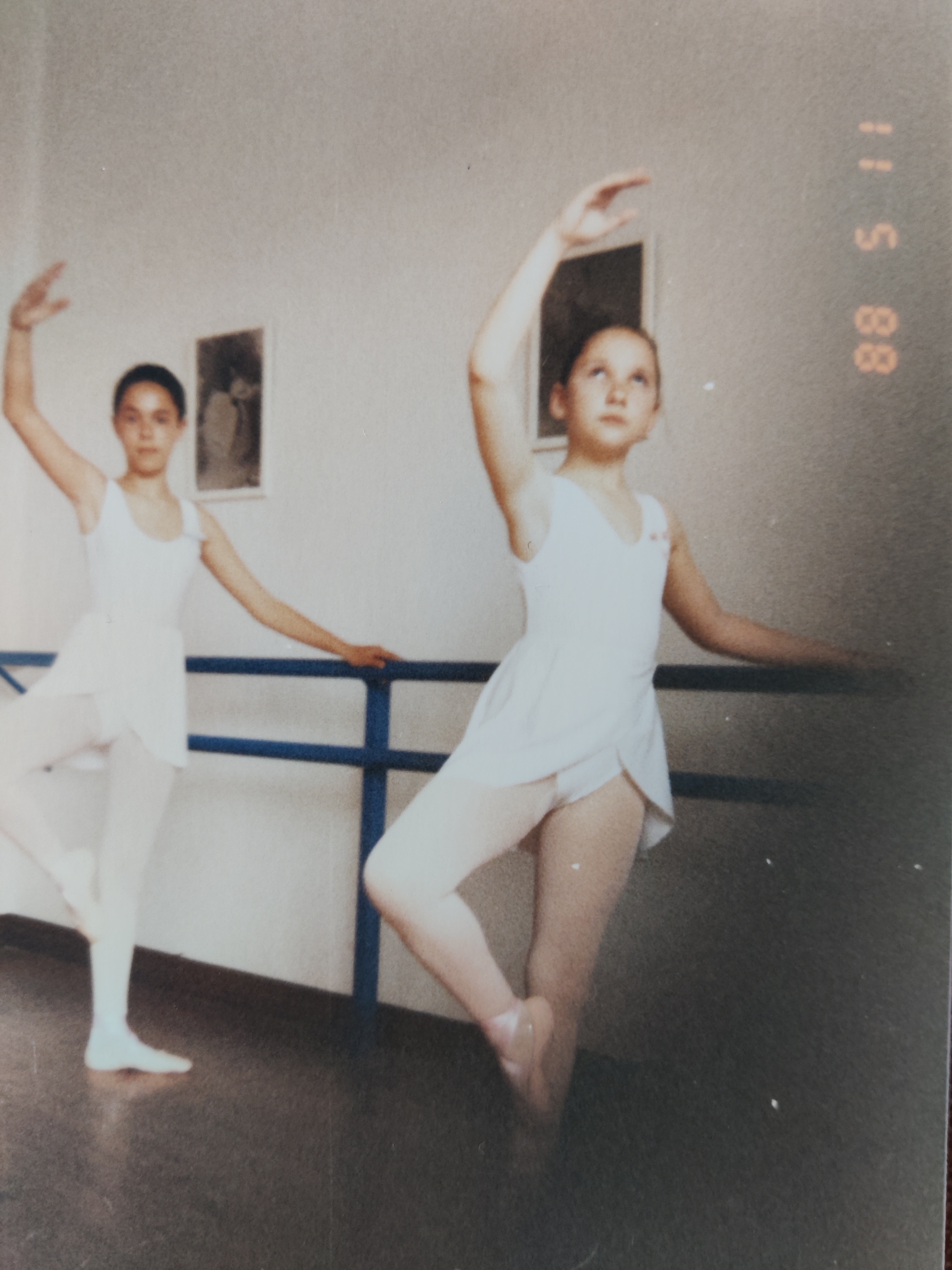
Old photograph of two girls in a ballet class, holding on to the barre

There I am with my friend Araceli, at our ballet class, back when we were ten years old. Such good memories...

My parents signed me up for ballet at Sbelta school of dance, in Cáceres, only a short walk away from my house, when I was four years old, and I stayed there learning classical and contemporary dance for another fifteen years! Until I turned nineteen. I was never any good at sports, but I did love dancing, so dancing became a huge part of my life during my childhood and teenage years.

I remember those times with great fondness and excitement: spending our evenings in "the school", being in class with my friends, preparing our exams with the Royal Academy of Dance (with an examiner coming from England to evaluate us), rehearsing, rehearsing and rehearsing before a performance... And above all, performing.

Overcoming my nerves, setting aside my lack of confidence and getting on stage. Showing myself to the world.

Two years ago I was lucky enough to bump into Cristina, my former teacher, and briefly get to walk along the school´s corridors once again. I realized how much I had learned from the world of dance, despite the fact that I left once I reached a certain age and never considered it "seriously" as a career option:

  • An appreciation for music and performing arts.
  • Discipline and consistency to keep at it, even on days when I didn't feel like it.
  • Patience and tolerance to frustration when things didn't go smoothly first time round (or sometimes second, or third...).
  • The ability to quickly recover after slipping or messing up (= stop beating myself up over the mistake, and keep going).
  • Comradery and fellowship - while it wasn´t exactly the same as a team sport, rehearsing and performing together created a similar bond.

And then of course, it helped me to lose a bit of that fear to expose myself, and acquire "tablas", which the Spanish RAE dictionary defines as "experience and easiness when performing in public or developing an activity".

All of this goes to illustrate the idea that I wanted to convey to those boys and girls at the secondary school: you can learn lots of things through hobbies, interests and extra-curricular activities; those things are often different from the ones you get to learn in school, and most of those skills and learnings are transferrable to other personal and professional areas. Which means that, even at the very beginning of our working career, chances are we´re not starting from scratch, there are probably a few resources alrady in our backpack.

This is the "useful" or "practical" benefit of having a hobby; then there are other less tangible benefits, like the excitement and satisfaction we get out of practicing that activity. For me in particular, as I have a tendency to think (or overthik?) and I´m rather sedentary in nature, I find it hugely beneficial to get in contact with my body and express myself through movement. And that´s exactly why I recently signed up for an adults ballet class! I started last Thursday, and leaving aside the initial shock at my complete lack of balance, strength and stamina, the truth is I´m delighted 🙂

Thinking about all this I remembered Billy Elliot , the musical (which I loved and I totally recommend) where they ask the main character how it feels when he's dancing. Here are two videos with the lyrics.

The original song, in English:

A translation into Spanish (with occasional spelling mistakes, please disregard those)

Now, back to the question: What activity did you really enjoy as a child? How did you use to feel? And what did you learn from it?

Untranslatable sentences: kidult

Today I'm returning to one of the blog's recurring themes: words and sentences I find difficult to translate between English and Spanish without them losing their charm or part of their meaning (you can see previous articles in this category: untranslatables).

And today's word is... KIDULT.

Action figures of Luigi, Yoshi and Mario from Nintendo's Super Mario videogames

According to Cambridge Dictionary, a kidult is "an adult who likes doing or buying things that are intended for children". It's a combination between the words "kid" and "adult". The Urban Dictionary goes a step further and describes it as "an adult who never grew up", and Wikipedia links it to the Peter Pan syndrome.

I heard this word for the first time from an Irish economist, David McWilliams, and as I understood it, he was referring to a very common tendency in recent generations: people reaching adulthood and still continuing to behave like spoiled kids (only with more disposable income), delaying more and more the phase of maturing and taking on responsibilities..

And when you look at it that way, it's a big problem. But the problem is not caused by adults still liking Disney movies or videogames (I don't think anybody is even surprised by that). As I see it, the problem is that we're living an epidemic of lack of emotional maturity and personal responsibility. Because these two qualities don't come automatically as one comes of age; on the contrary, they need work, and it's each person's decision to make the effort to develop them, or otherwise choose the easy way - escapism and excuses.

That's the "official" (or at least the most extended) definition of kidult, and honestly, I find it a bit depressing... But what if we turned it around? Today I'd like to propose a different way to approach this mix between kid and adult, this time choosing the best of both worlds, instead of the worst.

What if we were able to become adults with the soul of a kid?

We would be more conscious and aware; we would realize that being mature and responsible doesn't mean always being serious and never having fun. We would know how to enjoy the little everyday things even more, and how to connect with the excitement, spontaneity and creativity of our inner child. We would dare to laugh at ourselves more (and to laugh more, in general), and also to play, experiment and live life as it comes.

I have to admit it took me quite a few years to learn this alternative lesson in "kidultism", and even today, I'm still learning. I've always had a huge sense of personal responsibility, so up until very recently, my tendency has been to behave rather in the opposite way, what in Spanish we could call viejoven (also very difficult to translate, a combination between the words for "old" (viejo) and "young" (joven), like being young but behaving like an old person).

Having said that, I think I've been making progress lately at becoming a bit more of a kidult (in a good way)... A few years ago, if somebody had suggested buying the girls a ping-pong set for the kitchen table, I wouldn't have thought it was a good idea; today, not only I said yes immediately (thanks Quique!), I also had a lot of fun getting to use it with Eva 🙂

What about you? Do you see yourself as a kidult? Or maybe a viejoven? Which one would you like to be?

Even those days

We are in mid-January, and by now, those new year´s resolutions may be starting to waver...

Maybe because of this time of the year, or maybe just by pure chance, a few days ago, Google put this quote in front of me:

Do something today that your future self will thank you for.

Sean Patrick Flanery
View from the inside of a round tunnel, with a cloudy sky visible through the opening in the centre of the image

Such a simple idea, and such an interesting one.

This phrase strikes me as a fantastic way to get motivated on "those days" we all have every now and then... Those days when everything seems to go wrong for us, when we make one mistake after another. Or those other days when we lack the will to do anything, as if our batteries had suddenly been depleted. Days when we´re feeling down, nervous o bad tempered, often without even knowing why.

Well, even those days seemingly destined to go to waste can be rescued thanks to this question: what is it that I can do today that my self from tomorrow will thank me for?

Then, depending on the day and the specific situation, the answers may vary widely; perhaps at a certain point in time, that "something" will be giving yourself a little push (or a big kick!) to step into action with a task or project, while at another moment it will be the complete opposite, slowing down to rest and enjoy some quiet time. Or maybe the key will be to socialize more (or less) with certain people in your family, or in your group of friends.

Whatever it is, it doesn´t matter; what matters is switching off the auto-pilot for a moment, especially if it´s keeping us stuck in a loop, and consciously deciding what our next step will be, with intention. This simple act may seem unimportant, but I can assure you it´s not.

Which reminds me of another quote I have in my kitchen, stuck to the whiteboard (not easy to translate into Spanish, I must say):

Act as if what you do makes a difference. It does.

William James

What about you? What are you choosing to do today that your self from tomorrow will thank you for?

Re-education

Well, the Christmas break is over, I hope you had a nice holiday period. Now it's time to get back to our daily routine, in this month of January.

Photo of a calendar showing the month of January, with a pair of glasses on top of the page

How well are you coping with the holidays ending? I have to admit I usually find it a bit hard, especially when, like this year, there´s been a trip to Spain involved. Travelling disrupts our rhythms big time; this is very obvious with children, and it may not be that obvious with adults, but that doesn't mean we're not affected. Granting ourselves an adaptation period can help a lot.

And that´s where the word from this post´s title comes into play: re-education. Let me explain.

My three daughters were born in Ireland, and with both sides of their family being from Spain, they´ve spend all their lives travelling regularly for holidays, since they were babies. They´re real pros at this stage! Leaving aside the two years of the pandemic, every summer except one we´ve travelled to Spain for several weeks during the summer break, and we´ve spent many Christmases over there too, usually splitting our time between Cáceres and León. Now that they´re older, everything is much easier (Irene is 17 years old, Alicia is 14, and Eva, 9), but especially when they were little, their routines, timetables, meals, etc. just went out of control. .And it couldn´t be any other way: on the one hand, they were not at home, they were in different places doing different things, with different (usually fewer) rules, and on the other hand, they had lots of attention, cuddles and presents from grandparents, aunts and uncles, cousins... So as a result, as days went by, things got messier, and their behaviour inevitably started getting worse and worse.

Then, once back home in Dublin, we used to start what their dad and I called "the re-education period": a few days to re-establish our house rules and get the girls to adapt to their routine again, which often ended up costing them a few tantrums and a handful of visits to the "thinking spot".

As I said, things are much better now that the girls have grown up; the level of re-education needed is nowhere near where it used to be. But there´s still a need for an adaptation period, and unfortunately, sometimes I forget about it and then bump into it head first, like this weekend for example... I realized not only Eva needed a bit of re-education; I needed it too.

Re-education to change from the Christmassy vibes to the seriousness and discipline of January. From the quietness of family time, walks around the city´s old quarter and good meals already prepared and served to the daily hustle of working, organizing around the house, preparing meals, and trying to carve out time for exercise, social life and personal projects. From "holiday" mode to "always on the go" mode.

Just thinking about it all stresses me out, and makes me want to procrastinate. I know from experience there´s no way I can get even close to achieving the number of things my head says I have to do. So I set the intention to be patient with myself and prioritize what´s important, including taking care of myself, because if I don´t take care of myself, I won´t have energy left to do any of the other things on my list.

What about you? Do you need re-education? What can help you in this transition? How can you make it easier for yourself?