How well do you cope with visitors at home? Do you stress out a bit (or a lot) over preparations?
This is what I was thinking about this morning, before driving to the airport to pick up my sister Cristina and my nephews Pablo and Andrés (welcome guys!). I used to get suuuuper stressed out when someone was coming to visit us at home, and then, as years went by, I was able to relax a little bit, thankfully!
(Photo of an arts and crafts heart Eva made in school a couple of years ago, permanently displayed on the kitchen´s whiteboard)
I think part of the problem, at least in my case, was the belief that my house had to be perfectly clean and tidy for me to be able to properly receive visitors. Now I realise that this was a reflection, on the one hand, of certain habits from my family in particular, and on the other hand, of the societal norms that ruled generations prior to ours.
In the old days, many houses had a room specifically dedicated to visitors (a place where children were generally not allowed to enter, just in case they dirtied or broke anything), and "the good tableware" was used to serve tea, coffee, and/or refreshments. It was unthinkable to have visitors venturing as far as the kitchen, or the family rooms... Unless the hostess decided to show them the whole house, as my mother did every now and then (ah, the memories, getting into panic mode and rushing to tidy up our bedroom in record time so that it could be shown to whoever was visiting).
Thankfully, nowadays things have changed. Houses have more open layouts; a lot of daily life happens in the kitchen, and social relationships tend to be much less formal. Or maybe it´s just me: years ago, I decided I didn´t want any "visitors" in my house, or rather, I didn´t want anybody coming to see us to feel like they were a visitor (defining visitors in the old way, as in "stay in your designated area"). The meeting point in our current house is definitely the kitchen, which is a simple space, nothing luxurious, but very cosy and welcoming, and I no longer feel (so) bad about the house not being perfect, although I, of course, like to keep it reasonably clean and tidy.
At the end of the day, what really matters is us being able to get together and have a good time. And I have learned that being more flexible and simplifying certain things allows me to enjoy the moment a lot more, and of course, to enjoy the company.
What´s your take on this? Are you in favour of entertaining visitors, or would you rather have "non-visitors"?
Today, Google Photos helped me remember where I was approximately a year ago: looking around the shop at a well-known American petrol station chain: Buc-ee´s (thanks, Tasha!)
There was a section full of posters, placards and greeting cards with really cool messages, and two in particular caught my attention. But before I show you the first one, for the Spanish-speaking folks, I have to explain an expression in English that we could include in the category of untranslatables: to have your ducks in a row, which literally translates as "tener tus patitos en fila".
Have you ever seen a mammy duck walking with her ducklings? They give you a sense of order and discipline, right? Well, that´s exactly what this phrase conveys: having everything prepared and well organised, everything under control, leaving no loose ends. At work, we use this expression quite frequently when talking about tasks or projects, or, for example, this week, as we´re getting ready to do our quarterly planning, and we want to make sure everything is in order.
OK, once that´s understood, here´s the first picture, a greeting card:
("I do not have ducks. Or a row... I have squirrels, and they´re everywhere.)
Have you ever seen, or, if you haven´t, can you imagine, a family of squirrels running and jumping in different directions? Unpredictable and chaotic; the complete opposite of a family of ducks, isn´t it? Who hasn´t experienced at least once the feeling that they´re losing control, and things are starting to get out of hand?
Which takes me to the second picture, this time it´s a lovely placard that I was very close to purchasing:
("As long as everything is exactly the way I want it, I´m totally flexible)
I think this phrase is absolutaly brilliant, and it fits me like a glove, being an Enneagram type 1 as I am. It humorously portrays the hurdle I tend to trip over much more often than I would like: having unrealistic expectations and then responding rigidly every time they´re not met (and today it happened again, sorry you got the scolding girls).
Linking this idea with the previous one, I realise that, generally, everything is fine and I can go with the flow and be content until one (or several) of the ducklings wanders off the row, and that´s when I catch a glimpse of chaos and the disaster starts... To me, this placard is a reminder that it´s easy to make progress when things are going well for us; the difficult part is not to ruin it all when things start going not so well, which, let´s be realistic, it´s going to be quite often, because life looks a lot more like the family of squirrels than the family of ducks, however hard this may be to accept.
What do you think of these two phrases? Do you identify with any of them? In which way?
The other day, while I was looking for something else on the internet, I bumped into an ad campaign launched by Netflix Spain in 2024, and I absolutely loved their slogan: "embrace everything you are".
I was only able to find the video in Spanish; I hope it´s understandable for those reading me in English. It´s about a woman who feels confused because she likes many different types of movies and TV series, which makes her wonder who she really is.
The truth is, I find the topic of identity extremely interesting, I´ve already touched on it a couple of times on this blog (for example, here and here). It´s important to remind ourselves often of the fact that we humans are extremely complex, and on top of that, contradictory (I´ve also been looking for another Spanish ad from years ago, with the slogan "live your contradictions", but I haven´t been able to find it).
In fact, a large portion of any personal development work involves a process of accepting and integrating those parts in all of us that are different and even contradictory, in our own personal way.
And, as it usually happens with these things, the work can be hard (sometimes, really hard!), but it´s worth it. First, it helps us to realise that there´s nothing wrong with us, we´re simply human beings, with all that it implies. And once we´re ready to accept everything we are and stop judging ourselves, feeling guilty and beating ourselves up, we can give ourselves permission to move forward and make whatever changes we want in our lives.
These days I´m having the opportunity to switch off from daily life to reconnect with certain things and people in my life, embracing my Spanish side without forgetting the Irish one. Happy St. Patrick´s week!
(Entrada del metro de Gran Vía, en Madrid, vestida de verde para celebrar la «semana de Irlanda», una campaña publicitaria de Turismo de Irlanda).
Today, we´re continuing with the basic concepts of the Awareness to Action model (also called ATA), by Mario Sikora, a methodology based on the Enneagram of Personality that provides powerful and practical tools for personal and professional development.
The other day, we looked at one of the dimensions of this model, the three instinctual biases, and today we´re going to focus on the other one, the nine strategies. Each dimension describes a different aspect of the way we are, and when we combine them, we get 27 personality profiles, which, even though they don´t explain everything about people (not even close!), they do provide plenty of information regarding patterns of thought, emotion and behaviour that are habitual and characteristic of each profile.
You may be wondering, what´s the use of all this? Well, apart from allowing us to understand people better (starting with ourselves), it allows us to recognise when those non-conscious patterns (our good old autopilot, heavily influenced by the elephant) are causing us trouble instead of helping us, so that we can take control and choose a more adaptive option depending on the circumstances, achieving better results, and with less suffering along the way.
In other words, have you ever heard that humans are the only animals to ever trip over the same stone twice? Well, working with the Enneagram helps us to discover those stones we keep tripping over again and again, and to figure out what to do to in order to come to terms with them.
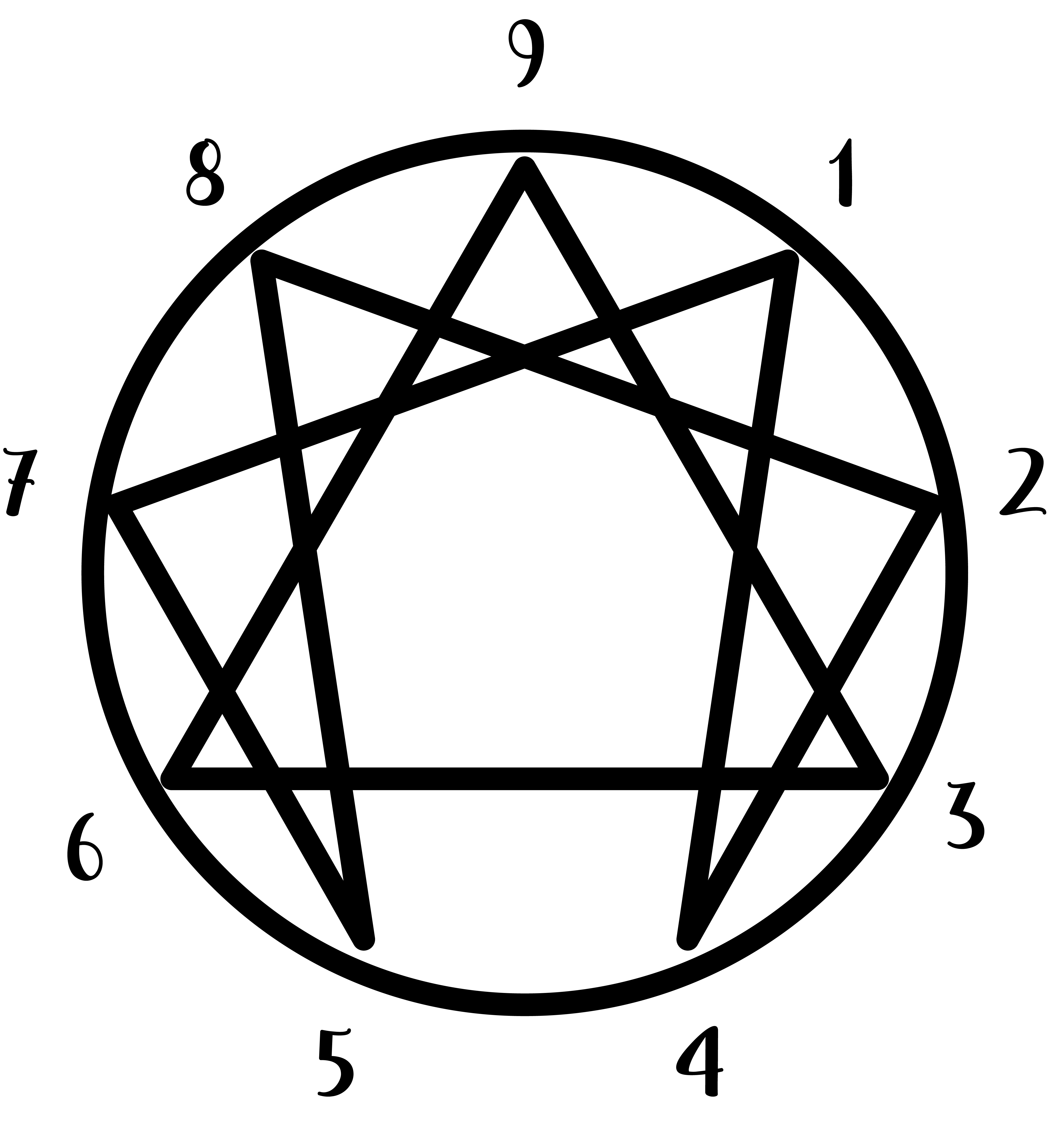
(Symbol of the Enneagram: nine points placed around a circle, represented by numbers from 1 to 9, and with lines linking each point with another two points it relates to.)
So, let´s dive into the strategies. First of all, I want to clarify that when we say "strategy" in this context, we´re not referring to something conscious and deliberate coming from your rational mind, like when we talk about a market strategy, or a military strategy. Here, once again, we´re referring to non- conscious patterns; in this case, the specific way in which our brain has learned to face day-to-day problems and situations.
The other day we spoke about how the instinctual biases show us the needs that each of us considers most important (the ones related to preserving, navigating or transmitting, depending on the case). Well, the nine strategies show us the ways in which we tend to try and satisfy those needs. Each of us uses one of the nine strategies more than the other eight, and that´s what determines our Enneagram type.
The definitions of each ennea-type slightly vary depending on the approach to the Enneagram being used, and needless to say, they´re only the tip of the iceberg; there´s so much depth to explore underneath. In ATA, each strategy is defined by our striving to feel a certain way, and that way we want to feel becomes our deepest motivation, as well as the filter through which we perceive life and interact with it.
Ennea-type 1 is striving to feel perfect.
Ennea-type 2 is striving to feel connected.
Ennea-type 3 is striving to feel outstanding.
Ennea-type 4 is striving to feel unique.
Ennea-type 5 is striving to feel detached.
Ennea-type 6 is striving to feel secure.
Ennea-type 7 is striving to feel excited.
Ennea-type 8 is striving to feel powerful.
Ennea-type 9 is striving to feel peaceful.
These "ways of feeling" determine the "default mode" in which we operate most of the time, and, as you can see, they go way beyond behaviour: in reality, they are nine totally different ways to understand the world.
I like the way Alberto Peña Chavarino explains this: it´s as if we were all wearing glasses with tinted lenses of a specific colour, perhaps pink, or green, or blue, and therefore we see life as if filtered through that colour, while other people see it in a different colour because the tint in their glasses is different. I would dare say that the majority of problems, frustrations and misunderstandings we have in life are due to not realizing, first, that we´re wearing the glasses, and second, that others are wearing other glasses that are not like ours.
This depth is precisely what distinguishes the Enneagram from other personality models: we´re not focusing on behavious here, as one same behaviour can come from very different motivations. We focus on what lies behind, what ultimately causes that behaviour (or that way of thinking or feeling). That´s why we have to be very careful with the words used, and go beyond them, to the intention, to the why.
For example, when somebody tells us that they´re a "perfectionist", we can fall into the trap of immediately thinking they´re Enneagram type 1, the one striving to feel perfect. But what exactly do we mean by perfectionism, and what´s the motivation behind those behaviours? It could indeed be a type 1 trying to be morally correct and adhere to the established rules, but it could also be a type 3 looking to show excellence, and therefore be outstanding, or a type 6 looking to avoid risks that could jeopardise their job.
In a similar way, the same perception of "wanting others to be happy" may originate from several different motivations: do I want to help you to feel good, so that I feel connected to you and valued, like a 2 would do? Do I want you to be happy so that you don´t bring me down, and I can be happy and excited, like a 7 would do? Or do I want to minimise my needs so that I´m not in your way and we get to keep the peace, like a 9 would do? As you can see, a single behaviour doesn´t confirm anything, though it is an observable data point that we can gather together with other data points, until a hypothesis starts to take form.
And once our hypothesis makes sense and we see consistency in the way we interact with life, we can start applying it to our personal and professional development work.
Let´s remember that the key to all this is NOT to identify as an ennea-type and simply accept it as what we are (or even worse, use it as an excuse to justify yourself and neglect to change). The idea is to realise that what we do habitually (how we think, how we feel, how we behave) so that we can make the most of it, and make it flexible whenever suits.
What do you think of all this? Do you see yourself reflected in one of the nine strategies? You may see yourself in more than one, and that´s also normal. Later on, we´ll talk about the connections between points in the Enneagram symbol, and how we can leverage them to our advantage.
This last Saturday, like almost every Saturday, I went to my Pilates class. I´m proud because I´ve been keeping this weekly habit for six months now, since back in August when they opened a reformer studio just around the corner from my house, and I, having wanted to try the reformer machines for many years, ran out of excuses not to start going.
I know a single class a week sounds like very little, but to me, considering that I´m allergic to gyms (mainly because I get really bored in them), and that my motivation when it comes to exercising is generally low, keeping it up for this long and still being excited about it is a great achievement.
I actually love the class, among other reasons, because we exercise not only our bodies but also our minds. The movements almost always change from one week to the next, and very often they´re new, or at least, new to me. So I have no other choice but to concentrate, to get the gist of what´s happening and be able to perform unfamiliar movements with a good degree of control and precision.
And it was precisely during the class that I remembered this well-known quote: mens sana in corpore sano, which is Latin for "a healthy mind in a healthy body". This is a good reminder of how our physical health is very closely related to our mental health, and how we need to look after both, as an investment in quality of life in the short, medium and long term.
The ancient Greeks used their gymnasium to combine physical training with philosophy and other intellectual pursuits. But interestingly, this quote doesn´t come from the Greeks as I thought: according to Wikipedia, it appears for the first time in a Satire from the Roman poet Juvenal, in the times of the Roman Empire. It´s part of a longer poem, and by the way, its original meaning has nothing to do with how we interpret it nowadays: it talks about the necessity of praying in order to have a balanced spirit in a balanced body.
Whatever the case may be, nowadays we know that a balanced spirit and a balanced body (or rather, a healthy mind and a healthy body) are not things that happen overnight, or by chance,, or needless to say, by magic; instead, we have to build them up little by little, one habit at a time.
So we come back to something I´ve probably mentioned several times in this blog already: looking for ways to exercise our bodies and minds that truly align with our lifestyle and work well for us, because otherwise, we´re not going to maintain them. Some people get motivated by team sports, martial arts, or running; in my case, it´s more about going for walks and practising yoga and Pilates. I could do more, but I could also do less, and now that the weather is improving (or at least I hope so!) and there´s more of a stretch in the evenings, I know that going out to "perform photosynthesis", as my friend Juanjo would say, is going to be hugely helpful in keeping my motivation and energy levels high.
(Photo I took yesterday during a walk; it´s the same tree that appears in this other post.)
What´s your favourite way to exercise your body? And your mind?



 English (UK)
  Español