This past week, at work, I gave my first talk on the topic of instinctual biases, one of the two dimensions of the Awareness to Action model I mentioned a couple of months ago.
This part of the model describes three domains or areas of life that we all focus on without really noticing, as they are essential for our survival, and ultimately, for the survival of the human species. But the interesting thing is that we don´t realise how much attention we give to them (hence the word "instinctive", as they´re non-conscious tendencies), and even more interesting is the fact that this attention is not equally distributed among the three areas; instead, each of us prioritises one of them way above the other two (hence the word "biases", which are nothing more than tendencies to follow certain patterns).
Crucially, these instinctual biases are a determining factor in many of our decisions and everyday behaviours, so, going back to the analogy of the elephant from the other day, by being aware of these biases, we´ll be able to detect their influence on us, and work with them so that they help us instead of hindering us.
But before telling you about these three domains, there are two things I would like to clarify:
- First, that us human beings are incredibly complex (and contradictory!), and there are a multitude of factors that influence our personality (remember the layers of the iceberg, and then add other aspects like family, culture, demographics, life experiences, etc., etc., etc.). This model doesn´t intend to explain everything about a person, not even remotely; that would be simply impossible. But it does explain several things that can provide significant value. As the famous quote attributed to George Box says: "all models are wrong; some models are useful".
- Second: that this is not about labelling people, or putting them into boxes. It´s about realising that we´re already in a box, we´re already conditioned, and by being aware of that conditioning, we can make our "box" more flexible and adapt better to the circumstances at any given moment. So it´s not a question of defining who we are through this classification (or any other); it´s all about observing how we behave, and above all, the things we habitually do most of the time, so as to distinguish the moments when our auto pilot tends to get us into trouble or create misunderstandings.
In view of all this, the three instinctual domains in Awareness to Action are formulated as verbs, representing clusters of behaviours:
- Preserving
- Navigating
- Transmitting
All these behaviours are, in reality, evolutionary adaptations we´ve inherited from our ancestors; they were useful to our ancestors, in the sense that they allowed them to survive at least long enough to reproduce, thus ensuring the continuity of our species.
Note: if you´re already familiar with the Enneagram through books or other schools or traditions, as there are several approaches, you may be familiar with other names used for the three subtypes under each Enneagram type. It´s not only the name that´s different here: chances are these concepts are broader than the ones you may have learned before, so you may need to do some "unlearning" to be able to grasp their full meaning and scope.
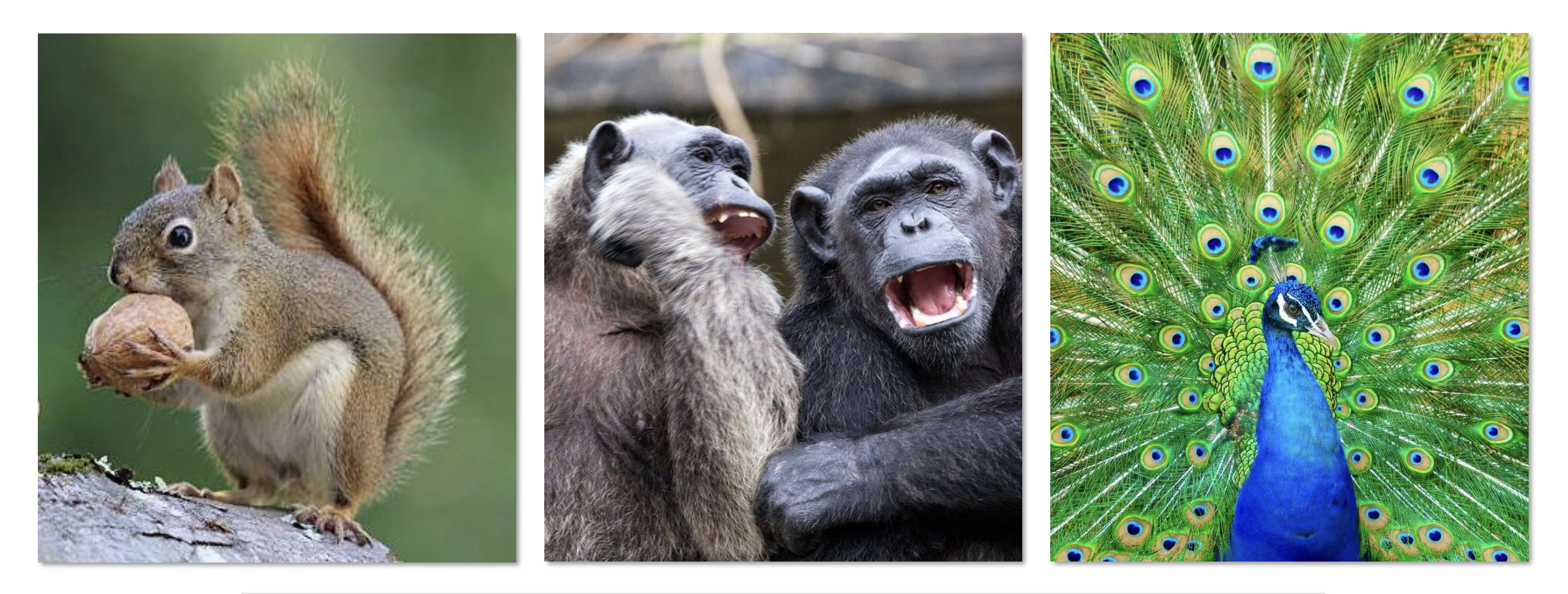
(Photos of a squirrel, two chimpanzees and a peacock, symbolising the three instinctual domains.)
We will get into more details for each instinctual domain and its corresponding bias in future articles; for now, let me give you some very broad strokes, including the symbols we use, which will hopefully help with understanding:
The preserving domain focuses on "nesting and nurturing", that is, making sure the fundamental survival needs are met, both for oneself and one´s family or close ones: for example, food, shelter and protection from external threats. It´s associated with the image of a squirrel, which we can visualise getting ready for the winter.
The navigating domain focuses on "orienting to the group", that is, understanding people and how they interact socially and within groups. Building alliances, creating trust and reciprocity, and understanding how oneself and others fit into the group. It´s associated with the image of some monkeys or chimpanzees, as these animals also form social groups with somewhat complex rules.
The transmitting domain focuses on "attracting and bonding", that is, behaving in ways that attract attention and leave a mark, so that they can transfer not only their genes (though that´s part of it as well), but also other things as their beliefs, values, interests and worldview to others, in order to make them carriers of that information. It´s associated with the image of a peacock, displaying its colourful and elegant feathers.
What do you think of these three domains? The are all necessary, and all of us do things in order to satisfy needs in all of the three areas.
But, as I said before, we don´t pay the same attention to all three of them: for some reason, we consider the needs related to one domain more important than those of the other two, and therefore, we prioritise the behaviours aimed at satisfying those needs. In a way, they become like a system of values we conform to without realising. And as a consequence, the other two areas are given lower priority, especially one of them, which always ends up at the bottom of the list... But we´ll talk about all of that in future articles.
Do you see yourself predominantly in one of these domains? Or maybe you´re torn between two, or even the three of them? As we get deeper and deeper into the model, hopefully the mystery will be solved... For the moment, as always, observation (and above all, self-observation) is the best exploration tool that will allow you to make interesting discoveries.
 English (UK)
  Español