Awareness to Action: Enneagram Strategies

Today, we´re continuing with the basic concepts of the Awareness to Action model (also called ATA), by Mario Sikora, a methodology based on the Enneagram of Personality that provides powerful and practical tools for personal and professional development.

The other day, we looked at one of the dimensions of this model, the three instinctual biases, and today we´re going to focus on the other one, the nine strategies. Each dimension describes a different aspect of the way we are, and when we combine them, we get 27 personality profiles, which, even though they don´t explain everything about people (not even close!), they do provide plenty of information regarding patterns of thought, emotion and behaviour that are habitual and characteristic of each profile.

You may be wondering, what´s the use of all this? Well, apart from allowing us to understand people better (starting with ourselves), it allows us to recognise when those non-conscious patterns (our good old autopilot, heavily influenced by the elephant) are causing us trouble instead of helping us, so that we can take control and choose a more adaptive option depending on the circumstances, achieving better results, and with less suffering along the way.

In other words, have you ever heard that humans are the only animals to ever trip over the same stone twice? Well, working with the Enneagram helps us to discover those stones we keep tripping over again and again, and to figure out what to do to in order to come to terms with them.
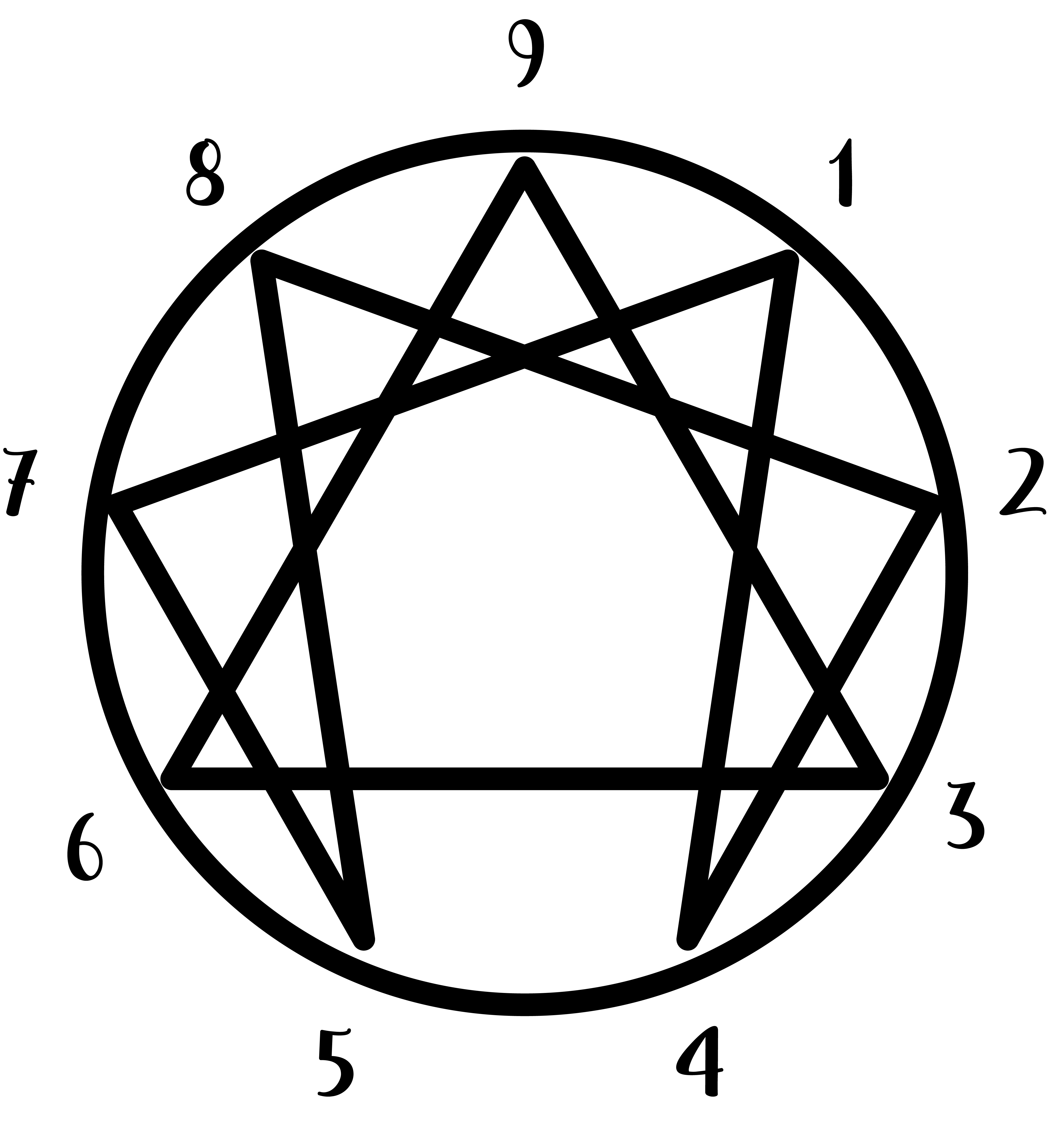
(Symbol of the Enneagram: nine points placed around a circle, represented by numbers from 1 to 9, and with lines linking each point with another two points it relates to.)

So, let´s dive into the strategies. First of all, I want to clarify that when we say "strategy" in this context, we´re not referring to something conscious and deliberate coming from your rational mind, like when we talk about a market strategy, or a military strategy. Here, once again, we´re referring to non- conscious patterns; in this case, the specific way in which our brain has learned to face day-to-day problems and situations.

The other day we spoke about how the instinctual biases show us the needs that each of us considers most important (the ones related to preserving, navigating or transmitting, depending on the case). Well, the nine strategies show us the ways in which we tend to try and satisfy those needs. Each of us uses one of the nine strategies more than the other eight, and that´s what determines our Enneagram type.

The definitions of each ennea-type slightly vary depending on the approach to the Enneagram being used, and needless to say, they´re only the tip of the iceberg; there´s so much depth to explore underneath. In ATA, each strategy is defined by our striving to feel a certain way, and that way we want to feel becomes our deepest motivation, as well as the filter through which we perceive life and interact with it.

  • Ennea-type 1 is striving to feel perfect.
  • Ennea-type 2 is striving to feel connected.
  • Ennea-type 3 is striving to feel outstanding.
  • Ennea-type 4 is striving to feel unique.
  • Ennea-type 5 is striving to feel detached.
  • Ennea-type 6 is striving to feel secure.
  • Ennea-type 7 is striving to feel excited.
  • Ennea-type 8 is striving to feel powerful.
  • Ennea-type 9 is striving to feel peaceful.

These "ways of feeling" determine the "default mode" in which we operate most of the time, and, as you can see, they go way beyond behaviour: in reality, they are nine totally different ways to understand the world.

I like the way Alberto Peña Chavarino explains this: it´s as if we were all wearing glasses with tinted lenses of a specific colour, perhaps pink, or green, or blue, and therefore we see life as if filtered through that colour, while other people see it in a different colour because the tint in their glasses is different. I would dare say that the majority of problems, frustrations and misunderstandings we have in life are due to not realizing, first, that we´re wearing the glasses, and second, that others are wearing other glasses that are not like ours.

This depth is precisely what distinguishes the Enneagram from other personality models: we´re not focusing on behavious here, as one same behaviour can come from very different motivations. We focus on what lies behind, what ultimately causes that behaviour (or that way of thinking or feeling). That´s why we have to be very careful with the words used, and go beyond them, to the intention, to the why.

For example, when somebody tells us that they´re a "perfectionist", we can fall into the trap of immediately thinking they´re Enneagram type 1, the one striving to feel perfect. But what exactly do we mean by perfectionism, and what´s the motivation behind those behaviours? It could indeed be a type 1 trying to be morally correct and adhere to the established rules, but it could also be a type 3 looking to show excellence, and therefore be outstanding, or a type 6 looking to avoid risks that could jeopardise their job.

In a similar way, the same perception of "wanting others to be happy" may originate from several different motivations: do I want to help you to feel good, so that I feel connected to you and valued, like a 2 would do? Do I want you to be happy so that you don´t bring me down, and I can be happy and excited, like a 7 would do? Or do I want to minimise my needs so that I´m not in your way and we get to keep the peace, like a 9 would do? As you can see, a single behaviour doesn´t confirm anything, though it is an observable data point that we can gather together with other data points, until a hypothesis starts to take form.

And once our hypothesis makes sense and we see consistency in the way we interact with life, we can start applying it to our personal and professional development work.

Let´s remember that the key to all this is NOT to identify as an ennea-type and simply accept it as what we are (or even worse, use it as an excuse to justify yourself and neglect to change). The idea is to realise that what we do habitually (how we think, how we feel, how we behave) so that we can make the most of it, and make it flexible whenever suits.

What do you think of all this? Do you see yourself reflected in one of the nine strategies? You may see yourself in more than one, and that´s also normal. Later on, we´ll talk about the connections between points in the Enneagram symbol, and how we can leverage them to our advantage.

Awareness to Action: Instinctual Biases

This past week, at work, I gave my first talk on the topic of instinctual biases, one of the two dimensions of the Awareness to Action model I mentioned a couple of months ago.

This part of the model describes three domains or areas of life that we all focus on without really noticing, as they are essential for our survival, and ultimately, for the survival of the human species. But the interesting thing is that we don´t realise how much attention we give to them (hence the word "instinctive", as they´re non-conscious tendencies), and even more interesting is the fact that this attention is not equally distributed among the three areas; instead, each of us prioritises one of them way above the other two (hence the word "biases", which are nothing more than tendencies to follow certain patterns).

Crucially, these instinctual biases are a determining factor in many of our decisions and everyday behaviours, so, going back to the analogy of the elephant from the other day, by being aware of these biases, we´ll be able to detect their influence on us, and work with them so that they help us instead of hindering us.

But before telling you about these three domains, there are two things I would like to clarify:

  • First, that us human beings are incredibly complex (and contradictory!), and there are a multitude of factors that influence our personality (remember the layers of the iceberg, and then add other aspects like family, culture, demographics, life experiences, etc., etc., etc.). This model doesn´t intend to explain everything about a person, not even remotely; that would be simply impossible. But it does explain several things that can provide significant value. As the famous quote attributed to George Box says: "all models are wrong; some models are useful".
  • Second: that this is not about labelling people, or putting them into boxes. It´s about realising that we´re already in a box, we´re already conditioned, and by being aware of that conditioning, we can make our "box" more flexible and adapt better to the circumstances at any given moment. So it´s not a question of defining who we are through this classification (or any other); it´s all about observing how we behave, and above all, the things we habitually do most of the time, so as to distinguish the moments when our auto pilot tends to get us into trouble or create misunderstandings.

In view of all this, the three instinctual domains in Awareness to Action are formulated as verbs, representing clusters of behaviours:

  • Preserving
  • Navigating
  • Transmitting

All these behaviours are, in reality, evolutionary adaptations we´ve inherited from our ancestors; they were useful to our ancestors, in the sense that they allowed them to survive at least long enough to reproduce, thus ensuring the continuity of our species.

Note: if you´re already familiar with the Enneagram through books or other schools or traditions, as there are several approaches, you may be familiar with other names used for the three subtypes under each Enneagram type. It´s not only the name that´s different here: chances are these concepts are broader than the ones you may have learned before, so you may need to do some "unlearning" to be able to grasp their full meaning and scope.

(Photos of a squirrel, two chimpanzees and a peacock, symbolising the three instinctual domains.)

We will get into more details for each instinctual domain and its corresponding bias in future articles; for now, let me give you some very broad strokes, including the symbols we use, which will hopefully help with understanding:

The preserving domain focuses on "nesting and nurturing", that is, making sure the fundamental survival needs are met, both for oneself and one´s family or close ones: for example, food, shelter and protection from external threats. It´s associated with the image of a squirrel, which we can visualise getting ready for the winter.

The navigating domain focuses on "orienting to the group", that is, understanding people and how they interact socially and within groups. Building alliances, creating trust and reciprocity, and understanding how oneself and others fit into the group. It´s associated with the image of some monkeys or chimpanzees, as these animals also form social groups with somewhat complex rules.

The transmitting domain focuses on "attracting and bonding", that is, behaving in ways that attract attention and leave a mark, so that they can transfer not only their genes (though that´s part of it as well), but also other things as their beliefs, values, interests and worldview to others, in order to make them carriers of that information. It´s associated with the image of a peacock, displaying its colourful and elegant feathers.

What do you think of these three domains? The are all necessary, and all of us do things in order to satisfy needs in all of the three areas.

But, as I said before, we don´t pay the same attention to all three of them: for some reason, we consider the needs related to one domain more important than those of the other two, and therefore, we prioritise the behaviours aimed at satisfying those needs. In a way, they become like a system of values we conform to without realising. And as a consequence, the other two areas are given lower priority, especially one of them, which always ends up at the bottom of the list... But we´ll talk about all of that in future articles.

Do you see yourself predominantly in one of these domains? Or maybe you´re torn between two, or even the three of them? As we get deeper and deeper into the model, hopefully the mystery will be solved... For the moment, as always, observation (and above all, self-observation) is the best exploration tool that will allow you to make interesting discoveries.

Awareness to Action

We´re in mid-December, and it´s time to start looking back at the year that´s now coming to an end. I have to say that 2025 has been a super busy year for me, both personally and professionally... But also, and probably for the same reasons, it´s been a tremendously rewarding year, one in which I believe I have grown and matured in many ways.

Professionally speaking, there are two highlights of this year for which I am incredibly thankful, and I´ll say it, also very proud. The first one I already told you in September: achieving my ACC certification.

The second one has been a whole journey of learning (and unlearning!) that began in January, and that I´m not going to say is just finished, because I´m sure I´m going to continue to learn... I´ve just completed the ATAAwareness to Action training and certification program, delivered by Mario Sikora and María José Munita, of Awareness to Action International. And to me, this has meant finding a fundamental piece of my coaching project, integrating the Enneagram.

(Symbolic image of the three instinctual biases that are characteristic to Awareness to Action´s methodology: preservers, navigators and transmitters. Thanks Óscar for the drawings!)

If you´ve been reading this blog for a while, you may have seen me timidly mention the Enneagram on a few occasions; very few, if we take into account that I´ve been studying it in detail for three years now... And this hasn´t been due to a lack of interest, not at all: I find the Enneagram fascinating, I believe it´s an incredibly helpful tool for personal (and professional) development.

It´s been mostly due to a lack of confidence in my ability to explain it well, to be able to convey its full value without falling into superficial stereotypes (putting us all in boxes rather than setting us free) or overcomplicated explanations (confusing us even more instead of helping our understanding). And I´m sure there´s still more progress for me to make on this, but at least, today I can finally say that I have that confidence.

At this point, it´s good to clarify what we mean exactly when we say "the Enneagram". In the most literal sense, the Enneagram is a symbol named after two Greek words: ennea means "nine", and gram, "line", and indeed, this diagram is formed by nine lines, connecting nine points distributed around a circle.

This symbol is used as part of a personal development tool, called "the Enneagram of personality", which describes nine different personality profiles and the way they are interconnected following certain patterns.

Now, what not many people know is that there´s not a single fixed and static "Enneagram" as such, in the sense that it´s not a proprietary system of personality typing like DISC or MBTI (Myers-Briggs). In the Enneagram world, there are multiple approaches and schools of thought, some older and some more recent, that have been evolving and getting refined over time, in the same way the fields of psychology, philosophy and many other disciplines have been progressively evolving and building new approaches based on previous ones.

If we were to compare it with an operating system, for example, it wouldn´t be like Windows or Mac OS, but rather like Linux - open source, available for everyone to create their own versions, enhancements and contributions.

The thing is, one of the current problems we see with the Enneagram is that many people are learning it from books that were written many years ago, using certain concepts and ideas that are obsolete nowadays, and for which now we have better explanations, based on practical applications of the model over the years. Or even worse, they only get a partial version of those stereotyped concepts and ideas, in the form of hypersummarized descriptions and superficial jokes published on social media.

And to be honest, it´s a pity, because the Enneagram, when it´s well understood, well explained and well applied, is surprisingly powerful, both for its depth and its simplicity, and tremendously helpful for personal work, as well as for professional growth.

That´s why I´m so happy to have found an approach to the Enneagram that allows me not only to understand it in all its depth, but also to explain it in clear and simple terms, and to apply it to practical situations inside and outside my coaching practice. So, from January onwards, you can expect a lot more blog content on the Enneagram; I´ll explain the methodology behind Awareness to Action, or ATA, its different components and how they relate to each other.

Thanks a million again, Mario and María José, for your generosity over the last year, sharing your wisdom and the model you´ve built through many years of working in the field. Also, thanks Lee, Micky and Creek for your support, each of you in your own style and with your own perspectives, and thanks to all my classmates for the time we shared. And of course, I also want to thank Autognosis, the school where I got my Enneagram foundation in the first place: Alberto, Laura, Fernando, Rafa, Luis, Benoit, Ana B and Ana M. Thank you!