Today, we´re continuing with the basic concepts of the Awareness to Action model (also called ATA), by Mario Sikora, a methodology based on the Enneagram of Personality that provides powerful and practical tools for personal and professional development.
The other day, we looked at one of the dimensions of this model, the three instinctual biases, and today we´re going to focus on the other one, the nine strategies. Each dimension describes a different aspect of the way we are, and when we combine them, we get 27 personality profiles, which, even though they don´t explain everything about people (not even close!), they do provide plenty of information regarding patterns of thought, emotion and behaviour that are habitual and characteristic of each profile.
You may be wondering, what´s the use of all this? Well, apart from allowing us to understand people better (starting with ourselves), it allows us to recognise when those non-conscious patterns (our good old autopilot, heavily influenced by the elephant) are causing us trouble instead of helping us, so that we can take control and choose a more adaptive option depending on the circumstances, achieving better results, and with less suffering along the way.
In other words, have you ever heard that humans are the only animals to ever trip over the same stone twice? Well, working with the Enneagram helps us to discover those stones we keep tripping over again and again, and to figure out what to do to in order to come to terms with them.
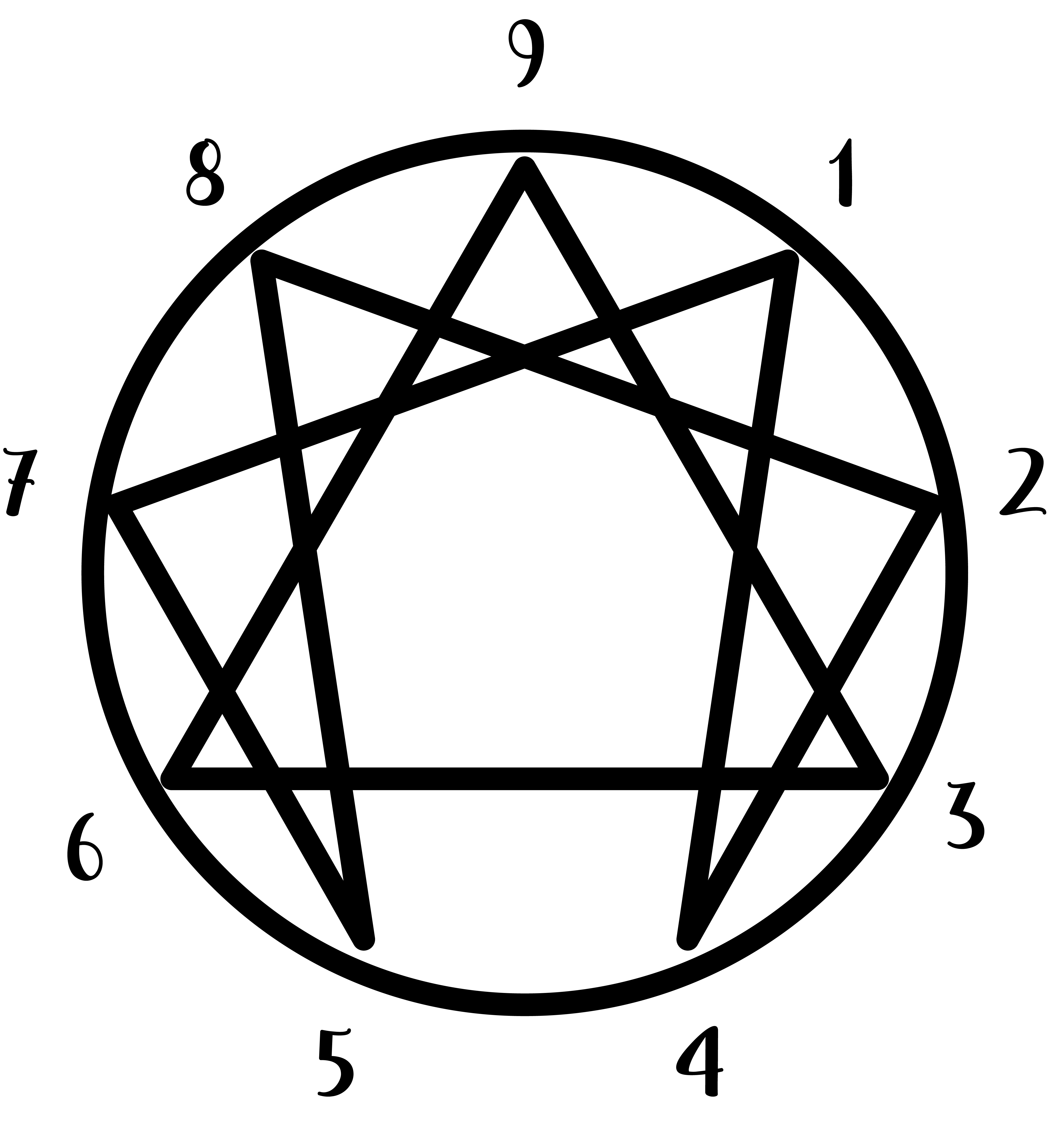
(Symbol of the Enneagram: nine points placed around a circle, represented by numbers from 1 to 9, and with lines linking each point with another two points it relates to.)
So, let´s dive into the strategies. First of all, I want to clarify that when we say "strategy" in this context, we´re not referring to something conscious and deliberate coming from your rational mind, like when we talk about a market strategy, or a military strategy. Here, once again, we´re referring to non- conscious patterns; in this case, the specific way in which our brain has learned to face day-to-day problems and situations.
The other day we spoke about how the instinctual biases show us the needs that each of us considers most important (the ones related to preserving, navigating or transmitting, depending on the case). Well, the nine strategies show us the ways in which we tend to try and satisfy those needs. Each of us uses one of the nine strategies more than the other eight, and that´s what determines our Enneagram type.
The definitions of each ennea-type slightly vary depending on the approach to the Enneagram being used, and needless to say, they´re only the tip of the iceberg; there´s so much depth to explore underneath. In ATA, each strategy is defined by our striving to feel a certain way, and that way we want to feel becomes our deepest motivation, as well as the filter through which we perceive life and interact with it.
- Ennea-type 1 is striving to feel perfect.
- Ennea-type 2 is striving to feel connected.
- Ennea-type 3 is striving to feel outstanding.
- Ennea-type 4 is striving to feel unique.
- Ennea-type 5 is striving to feel detached.
- Ennea-type 6 is striving to feel secure.
- Ennea-type 7 is striving to feel excited.
- Ennea-type 8 is striving to feel powerful.
- Ennea-type 9 is striving to feel peaceful.
These "ways of feeling" determine the "default mode" in which we operate most of the time, and, as you can see, they go way beyond behaviour: in reality, they are nine totally different ways to understand the world.
I like the way Alberto Peña Chavarino explains this: it´s as if we were all wearing glasses with tinted lenses of a specific colour, perhaps pink, or green, or blue, and therefore we see life as if filtered through that colour, while other people see it in a different colour because the tint in their glasses is different. I would dare say that the majority of problems, frustrations and misunderstandings we have in life are due to not realizing, first, that we´re wearing the glasses, and second, that others are wearing other glasses that are not like ours.
This depth is precisely what distinguishes the Enneagram from other personality models: we´re not focusing on behavious here, as one same behaviour can come from very different motivations. We focus on what lies behind, what ultimately causes that behaviour (or that way of thinking or feeling). That´s why we have to be very careful with the words used, and go beyond them, to the intention, to the why.
For example, when somebody tells us that they´re a "perfectionist", we can fall into the trap of immediately thinking they´re Enneagram type 1, the one striving to feel perfect. But what exactly do we mean by perfectionism, and what´s the motivation behind those behaviours? It could indeed be a type 1 trying to be morally correct and adhere to the established rules, but it could also be a type 3 looking to show excellence, and therefore be outstanding, or a type 6 looking to avoid risks that could jeopardise their job.
In a similar way, the same perception of "wanting others to be happy" may originate from several different motivations: do I want to help you to feel good, so that I feel connected to you and valued, like a 2 would do? Do I want you to be happy so that you don´t bring me down, and I can be happy and excited, like a 7 would do? Or do I want to minimise my needs so that I´m not in your way and we get to keep the peace, like a 9 would do? As you can see, a single behaviour doesn´t confirm anything, though it is an observable data point that we can gather together with other data points, until a hypothesis starts to take form.
And once our hypothesis makes sense and we see consistency in the way we interact with life, we can start applying it to our personal and professional development work.
Let´s remember that the key to all this is NOT to identify as an ennea-type and simply accept it as what we are (or even worse, use it as an excuse to justify yourself and neglect to change). The idea is to realise that what we do habitually (how we think, how we feel, how we behave) so that we can make the most of it, and make it flexible whenever suits.
What do you think of all this? Do you see yourself reflected in one of the nine strategies? You may see yourself in more than one, and that´s also normal. Later on, we´ll talk about the connections between points in the Enneagram symbol, and how we can leverage them to our advantage.
 English (UK)
  Español