What works best

Do you consider yourself a person of habit, used to always doing things the same way?

If the answer is yes, I have a quote for you:

Until you change how you get things done, you’ll never know what works best.

Roy T. Bennet

This is something that took me a long time to learn: over the years, I slowly came to realize that behind my perfectionism and my willingness to do everything "right" there was an unconscious belief that there was only ONE "right" way to do each thing, and that if I wasn´t able to do it exactly that way, then I was making a mistake, I was doing it "wrong". Moreover, every time I tried a new activity and didn´t get it right at the first try, I automatically assumed I was always going to be bad at it, and I rarely gave it a second chance.

Just imagine how incredibly limiting this thought can be... When in our minds there´s only one way of getting it right among a thousand ways of screwing up, it´s no surprise that the fear of getting it wrong causes us to feel tense, or even paralyzed.

But what if we could turn this around? What if there were a thousand ways of getting it right, or at least, a thousand ways of gathering information to guide us towards a better result?

Here´s where that famous quote from the inventor or the light bulb comes to mind:

I have not failed. I've just found 10,000 ways that won't work.

Thomas A. Edison
Woman holding a big drawing of a lightbulb, against the background of a white wall full of drawings and diagrams

That´s precisely the value of experimentation: learning from each try in order to find a better solution. Or several ones, as problems rarely have only a single solution.

But, to be able to try other ways of doing things, first we need to be able to come up with them, and our brain gets a bit lazy when it comes to blazing new trails... It´s much better at going back to the beaten tracks, as they´re easier to traverse and require far less energy.

One of the main benefits of coaching and self-discovery is that they help us to overcome that cognitive rigidity, that resistance we have to getting out of auto-pilot mode. This way, by realizing that the way we see things is just another perspective, as valid as many others, we can allow ourselves to consider other possibilities and viewpoints, and from there, expand our options range and find more adaptive solutions.

And while we´re in the process of trying new strategies and designing solutions that work better for us, we learn to trust that others can also find their own. Because, once the "single perfect solution" myth has been busted, we realize there´s no point in imposing our judgement on others: we each have our own style, our own worldview and our particular set of circumstances, and something that works for one person may not necessarily work for another.

So then, what can we do? Well, we can share our learnings and experiences with other people, explain what works for us, what doesn´t work, and why, compare strategies and points of view, and be open to trying new ways of obtaining what we need or want.

We can even take it as an experiment: if I change this variable, what happens? What changes? Does the result improve, or get worse? All of this knowing that your own result is personal and untransferable, and that the winning formula will probably be different for each of us.

So, with Mr. Benet´s permission, I´m going to slightly modify his quote:

Until you change how you get things done, you’ll never know what works best FOR YOU.

What about you? Do you already know what works best for you? What aspects of your life would benefit from some experimentation?

Productivity

What does "a productive day" mean to you?

I´ve realized I frequently judge how well my day went based on how productive it was... Or rather, on how productive I was. Does this sound familiar?

Silver letters forming the word "productive", on a background made with crumpled dark blue paper

Productivity is a topic I´ve always been interested in; in fact, it´s what first brought me to the personal development world. I remember the old times when I used to search for tips and strategies to stay on top of my never-ending to-do list. And I did find a few tools that helped me, but only to a certain extent.

Because in reality, what was happening to me was much more complex than I thought. As it's usually the case.

That´s why in coaching we like probing and digging a bit beneath the surface, because often times the "problem" our client is coming with is just a symptom of a deeper conflict or imbalance, which they themselves are unaware of. For example, time management issues tend to reflect underlying priority management issues, and procrastination may be caused by conflicting values or priorities.

A widely used coaching technique consists of asking questions like the one at the beginning of this article: "What does X mean to you?" This may seem silly, but at the end of the day, words are symbols we use to represent things, and when we´re discussing relatively abstract terms, our thoughts are much more complex than the words we use to describe them. Breaking down the word´s meaning and explaining it out loud (or in writing) can help us to make very interesting discoveries.

For example, the concept of productivity is linked to the action of "producing", and I´ve realized I used to believe that a person could only be productive when they were "producing" something tangible, something measurable. When I started my professional career, first as a programmer and later on as a systems analyst, it was easy for me to determine whether I was being productive or not, for I had documents, diagrams and lines of code as proof. Then as I progressed to a different kind of role, the game rules suddenly changed: there were more meetings and less defined tasks, and I found myself a bit lost; very often I would get to the end of the day with a feeling of not having contributed at all.

Then slowly but surely, I started adapting and evolving my definition of productivity. It took me years to get rid of the idea that the time I spent "chatting with people" (= at meetings, especially 1:1s) didn't count as work, because I wasn't producing anything. Now I know that talking to my colleagues and fostering work relationships not only it's not a waste of time, it's actually an essential part of my job, and it makes a huge difference in terms of pushing projects forward. Now that I know the transformational power of a good conversation, it's one of the things I enjoy the most.

And what about outside of work? Well, I've realized that this constant need to produce has a lot of weight in my personal life as well, so I still find it difficult to prioritize rest, leisure and self-care at the same level of importance as other things that "must be done". Without even noticing, I fill up my evenings and weekends with tasks to be completed, so that at bedtime I can say it was a productive day... But the good news is that now I'm aware of it, and I'm working on balancing it out, also being careful not to fall into the guilt trap.

What do you think? Is productivity important to you? And how do you measure it?

Career paths (II)

As I was telling you in my previous post, last week I had the opportunity to deliver a talk about my professional career to a class of secondary school kids.

I had a hard time preparing the presentation, partly because I generally find it difficult to talk about myself (and I don't like pointing at myself as an example of anything), and partly because I didn't have a clear idea of how to express what I wanted to convey. At this stage, I know for a fact that storytelling is not my thing, so I had to find another way.

Luckily, a couple of days before the talk I had a chat with a friend (thanks Quique!) who really helped me to put myself in those teenagers' shoes; we spoke about how at that age, typically only a few teens have a good idea of what they would like to study in college, or what they'd like to do for a living; most often, they don't have a clue. If on top of that we add the ever-growing amount of available options, and the rate at which the workplace landscape keeps changing, we end up with a level of uncertainty that's a lot higher than for previous generations. And that's overwhelming.

All this gave me an idea, a metaphor I could use to explain what I wanted to convey to them...

I remembered Dora the Explorer.

Dora the Explorer cartoon character, standing with her arms crossed and smiling

If you've ever watched an episode of Dora, you'll remember that she always has a mission to accomplish, a goal to achieve, and that she keeps finding challenges and difficulties along the way, but in the end she always gets to achieve the goal (and to celebrate!)

So, what does Dora have (apart from her friend Boots) that helps her to overcome those challenges and difficulties?

First of all, a map.

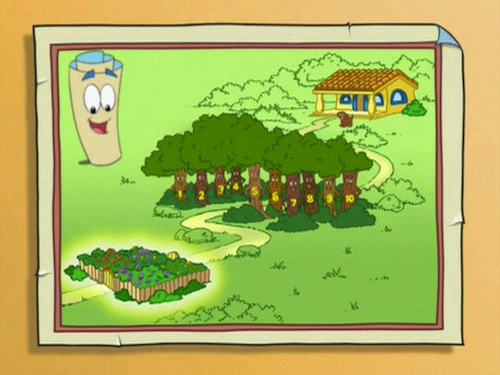
Map used to show Dora the way at the beginning of every episode, almost always with three places she had to get through before arriving at her destination:

But the thing is, Dora's map was always right, it knew exactly what she would find along the path... Obviously, in real life we know that "the map" (that is, our plan) is just for orientation purposes, and, following the reasoning from last week's post, something like this is most likely to happen:

So, you know, as I see it, it's great to have a map, a plan, especially at the beginning. It can help us, it can point us in the right direction, but it's not going to solve all our problems, so if we don't have a plan, it's not the end of the world either, the way will reveal itself in due course.

First message: it's OK if you don't have a plan, it's going to change anyway.

But then, what can we do to prepare?

This is where we get to the second object Dora always carried with her, which to me is a lot more important and a lot more interesting than the map. Do you remember what it was?

A backpack.

A backpack full of all kinds of tools. And every time a challenge appeared, Dora opened her backpack and took out the perfect tool for the occasion, the one that would allow her to solve the problem.

Cartoon - Backpack and Map from Dora the Explorer

Second message: we may not know the exact path we will need to walk, but in the meantime we can get our backpacks ready, filling them with tools that will be useful for work an well as for our personal life and relationships.

Those "tools" can be:

  • Natural talents and abilities that we already have, and that we can continue to work on and improve.
  • Things we learn in a formal environment (primary and secondary school, college, workplace, etc.), and I'm not referring only to what's in the books (though that's important as well), but also many other skills we learn while we go through these experiences.
  • Things we learn in less formal environments, and that we seek for ourselves: extra curricular activities, interests, hobbies...

In summary: everything we learn in the different environments we interact with gets incorporated into our backpack. And out of all those tools, the most useful ones are the ones called "transferrable skills", because they can be applied to any professional or personal environment. Here are a few examples of the most typical ones:

  • Communication and presentation skills
  • Organizational skills
  • Quality focus and attention to detail
  • Adaptability to change
  • Collaboration and teamwork

And my favourite, the best one in my opinion, because to helps to develop all the others: self-awareness and self-management.

What are your thoughts on this backpack idea? What tools do you have in yours? And which ones would you like to acquire?

Career paths (I)

One of the many things I love about the company I work for is the bunch of volunteering opportunities available to us. For a few years now I've been collaborating with Junior Achievement, an international institution who establishes links between students in primary and post-primary education and professionals from the corporate world.

The idea is for us volunteers to visit primary and secondary schools and deliver training sessions and other events to the kids, not only to bring them new knowledge (though that's part of it, especially in areas like economics, business, science, technology, engineering and maths), but mainly to be a role model for them; that way, they can see that staying in the education system pays off, as it gives them more chances to find a good job.

In previous years, I've done training sessions on science, technology and the like, but my task for this week was something very different: delivering a talk about my professional career to a secondary school class, in order to inspire them at this crucial moment when they're starting to decide what to do with their life.

My professional career.

Twenty years, more or less, since I started to work.

To be honest, at the beginning I didn't have a clear idea of what I could say that they would find inspiring, or at least somewhat helpful... How could I become a useful example for them? What did I learn in all these years that's worth telling? What would have helped me to hear when I was their age? I slowly started to dig deeper and deeper, and a common thread started emerging; an idea, a message that I would also like to share with you.

Diagram displaying a straight arrow from "start" to "end" with the label "How life is supposed to go", followed by another arrow full of twists, turns and loops between "start" and "end", and the label "How life actually goes"

This diagram is a great illustration of "how life is supposed to go" (a perfect straight line from the starting point to the end) versus "how life actually goes" (an extremely whacky and bendy line, full of twists, turns and even loops, from the starting point to the end).

This is as true for professional careers as it is for anything else in life: I realized this first hand as I was preparing my presentation, and I noticed I had drawn my trajectory as a perfect arrow from left to right, with significant milestones at regular intervals, when in reality there were a good few twists and turns, many of them unexpected, coming from outside, but also a few that I decided to initiate myself, from the inside.

Luckily, my presentation also had to include a section on "successes and failures", so that's where I took the opportunity to explain a few of those twists and turns along the years, which, depending on how you look at them, can be considered failures, in the sense that things didn't turn out how I expected them to.

And I said "depending on how you look at them" because this black and white thinking that states that things are either a success or a failure doesn't seem accurate to me; I prefer looking at it this way:

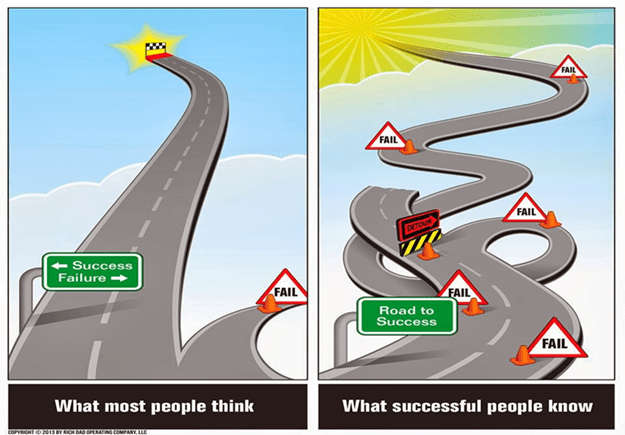
Two drawings: on the left hand side, over the label "What people think", a road forks into "Success" as the wide shiny road straight ahead and "Failure" as a narrow winding road to the side, blocked by an orange cone and a FAIL sign. On the right hand side, the "road to success" combines a few different road branches that twist, loop and end in FAIL with one that continues ahead, with another couple of FAILs along the way, and the shiny success at the end

This other diagram shows us "what most people think", which is that success and failure are mutually exclusive, and that failure derails you from the path of success, versus "what successful people know", which is that what we call failure is nothing more than feedback indicating which way not to go, so that we can try different routes and end up finding the right way, the way of success.

And this is something I would have greatly benefited from if I had heard it twenty years ago: that it's OK to make mistakes (at work and in life), that getting it wrong every now and then is completely normal, and it's even necessary, because it allows us to learn and make progress in life, figuring out our own path.

How about you? What do you think about these two diagrams?

  • If you've been in the workforce for a few years already, are these hypotheses true in your case as well? What would be the shape of your professional career, if you were to draw it? What twists, turns or blockers have you found along the way?
  • And if you've only recently joined the workforce, or haven't joined yet, how does it feel when you hear your professional career will probably be this chaotic? What do you think could help you to prepare a little better?

Next week I'll tell you something else that came to my mind when preparing for the talk: a way to think about your professional career that I hope will provide you with some fresh ideas and practical tools.

Stoic wisdom

According to the experts, one of the most effective things we can do to stay mentally and emotionally healthy is to keep learning for life learning new things that we enjoy and find interesting not only provides us with new knowledge, but also gives us motivation and flexibility, as well as opening our minds.

I wouldn´t be able to tell you when I first got interested in topics related to personal growth. I think part of it started when I moved from Spain to Ireland, as I was beginning a new life in many ways. Fast forward to the last few years, especially since the pandemic hit, and my interest in this field, together with the variety of specific topics and the time and attention I dedicate to them, have exponentially grown. But deep down, I believe this itch started way, way back.

For example, I remember really enjoying the subject of philosophy when we had it in school (3rd year of BUP, for whoever knows what that means); I even read a novel about the history of philosophy that our teacher recommended: Sophie´s world, and I also loved it.

Ruins of an ancient Greek temple against a blue sky with clouds

Many years later, I´ve bumped into the world of philosophy again, this time through a course on stoicism and enneagram (which I totally recommend, as every other course from Autognosis) that I´ve just finished this week.

To be honest, I´ve really enjoyed it, and the best part is that it´s a very practical kind of philosophy: a series of principles that we can apply to our day-to-day life, to be happier and suffer less. Nowadays we may think of philosophy as this complicated theoretical thing you can talk about (philosophize!) for ever, but so far removed from real day-to-day life that it doesn´t help at all, so nothing changes. But the ancient Greeks and Romans saw it differently: for them, philosophy was much more tangible, it was their way to get guidance in life. Back then, philosophers were the equivalent to today´s therapists and coaches.

There´s a lot we can learn from stoicism´s teachings and reflections, I´ll tell you some of them in blog articles as we go along. For the moment, today I´d like to leave you with a text you may already be familiar with; it´s relatively recent, but it has a lot to do with one of stoicism´s principles, one that resonates especially with me: the dichotomy of control.

The dichotomy of control warns us about the uselessness of spending energy trying to dominate what´s outside of our control, and encourages us to focus on what we can control instead, so that we get less frustrated and also achieve better results. And in that context, the prayer of serenity just fits perfectly:

Lord, grant me the serenity to accept the things I cannot change,
the courage to change the things I can,
and the wisdom to know the difference.

Reinhold Niebuhr

By the way, I just remembered that it was in that same philosophy class from school where I first heard about Socrates and his maieutic, one of the foundations of modern coaching 🙂

Rearview mirror

Today I got a question about the differences between going through a coaching process and visiting a psychologist, and I thought this would be an interesting topic to comment on here. When talking about professions dedicated to help and support, some terms are often confused or blurred, so I would like to explain the main difference as I see it, based on my own experience and what I´ve read and heard from experts, without getting into too much detail or pretending to be in possession of the truth (as I´m not a psychologist).

My understanding is that clinical psychology (or psychotherapy) is mostly focused on analyzing events that happened in the past, especially when involving traumas or disorders, so that the wounds created at that time can heal. In contrast, in coaching we work with the healthy side of the person (and the vast majority of us are healthy, just a bit confused as we walk through life).

Coaching focuses mostly on the present and future: where the person currently is, where they want to go, and how they can make progress to get closer to their goal. We only look back occasionally, and when we do, it´s with the purpose of recovering resources that the person already has and have worked well for them in the past, to see how they can be applied to this new challenge they´re now facing.

This was explained to me using the metaphor of a car, where the windshield is big and wide and lets us see everything that´s in front of us, while the rearview mirrors are much smaller. We can briefly look back when we need to, but the most important thing is to look ahead, and move forward..

Close up of a car rearview mirror with an empty street in the background, during the day. The mirror reflects the side of the car, and a person inside taking a picture with a camera

But that doesn´t mean that coaching can only happen at a superficial level; quite the opposite. Along the way, provided that the person takes ownership of their process and stays open to digging deep, they will come to realize many things about themselves, and about whatever is really preventing them from making progress in their desired direction, or at the pace they would like. This is not something that happens overnight, it requires a process: first, becoming aware of what's happening to them, and then doing the necessary work to change that situation, knowing that there will be ups and downs as they follow the path, and that the greatest value is not in achieving your goal fast, but in learning and evolving along the way.

Having said all this, I'd like to share a coaching exercise that I often use that looks back at the past in the way I've just explained. It's based on the fact that, when facing a new challenge, we often lack confidence that we´ll be able to achieve it, forgetting we've already achieved a considerable amount of other things in life. We get achievement amnesia. So, the exercise is precisely about remembering them, writing down an achievements list:

  • Get pen and paper, and dedicate three minutes to writing down everything you can think of that you have achieved in life. The more things the better, it doesn't matter if they're big or small: from learning to walk or drive to giving birth to a baby, getting a job, moving houses or cooking a nice Spanish omelette (which is somthing I truly admire, because I'm not good at it at all 🙂).
  • Once time is up, dedicate another three minutes to writing the skills, abilities and talents that you have and that have enabled to you achieve all these accomplishments.
  • Then read out loud your achievements list, together with the list of skills, abilities and talents, and realize how much you can achieve when you set your mind to it.

This exercise also works very well in pairs, where one person writes down what the other person is listing out loud. Limiting the time helps to come up with lots of ideas very quickly, instead of looking for big achievements and overthinking the whole thing. We're not looking for perfection or excellence: we're looking for quantity, a variety of situations that we were able to overcome, goals that we were able to achieve, and of which we can feel proud 🙂

What about you? What do you feel proud of when you look in your life's rearview mirror?

Success

What thoughts appear in your head when you hear the word "success"?

In my case, up until relatively recently, I always had the feeling that success was something out of my league, and that it was for other people, not for me. The things I did were ordinary, not extraordinary, and therefore, there was nothing I could think of that I had achieved and could be considered a success.

Photo taken at dawn - dark silhouette of a person standing on top of a rock, with their arms extended in victory, against the blue and pink sky

I remember how I used to hate it when I heard that cliché question: "what does success look like?", because I was never able to answer it. I didn´t have a clue.

These days, after years of learning about personal growth, at least I get to understand the question. It´s all about visualizing the result.

This concept is widely used in coaching: the first step is always to define a goal, and objective, something you want to achieve. But, how will you know that you have achieved it? What is that new situation that you´re so looking forward to? What will you see, what will you hear, what will you feel when that moment arrives? The more details, the better.

This is important for two reasons: first, because the better defined our desired state is, the easier it will be to achieve it (or at least, to get closer to it), as we will be giving clear instructions to our brain about what we´re looking for. And second, because each person has their own values, their own priorities and their own way of understanding life, and all those factors have (or should have) a massive impact on the kind of results we want to achieve, and also in how we value those results.

So, for each specific situation we get to work on, it´s good to think through what it is that we´re really aiming to achieve, keeping in mind that we may need to dig a little deeper to get to the truth: how will I benefit from achieving this goal? How far do I need to get to consider myself successful at it? And where does that measurement come from? Who sets the standard? Am I doing something that´s truly important to me, or am I trying to fulfil expectations?

Which brings me to today´s quote, and once again, it sounds to me much better in English than in Spanish; hopefully my loose translation will be understood by Spanish speaking folks:


Success isn’t about how your life looks to others. It’s about how it feels to you.

Michelle Obama

What about you? What does success mean to you, at this particular point in your life?

Annual check-up

Today it was time to take my car to the NCT (National Car Test), the Irish equivalent to the Spanish ITV (Inspección Técnica de Vehículos). The verdict was all OK except for one thing: the "ball joints" at the front right side, which are worn out and need to be replaced. I have to confess that I don't have the faintest idea about mechanics, let alone mechanics in English, so even if the dictionary tells me the Spanish term is "rótulas", I'm still completely clueless😀 Thankfully, the guys at the garage do know.

Anyway, thinking about this today, I realized that I would also benefit from an annual check-up, and I´m not talking about the doctor, the dentist or the optometrist (though those would also be good); I mean evaluating my life at this point in time, how things are going for me, what I´m happy about and what I´m not, and what I would like to change.

This can be done in many different ways; today, I´ve done it using a tool that´s both very simple and very powerful: the wheel of life.

It´s a graphical representation of our evaluation of the current moment in relation to different aspects of life. There are multiple versions with varying categories, scales, etc. The main idea is to choose the areas of life you consider most relevant, position them around a circle, score them individually, and then fill in the resulting "cobweb" to get a picture of the surface it covers.

Drawing of a "wheel of life" - eight segments representing different areas of life, and a graphical representation of a zero to ten score in each of them, creating a cobweb drawing

In this example, I´ve used a scale of zero to ten, positioning my eight chosen categories as radiuses of the wheel:

  • House / home / family
  • Health
  • Work
  • Friends
  • Love / relationships
  • Money
  • Hobbies
  • Personal growth

As you can see, it's a super simple exercise, very visual, but imagine how much can come out of it, as long as we're willing to be honest with ourselves and dig a bit deeper.

Then, once we have that "snapshot" of the current situation, there are many ways to work with the information it reveals. Ideally, the different areas in our wheel would be more or less balanced so that we can "roll" smoothly and effortlessly. Where is my wheel "limping" the most? Is there any area that needs immediate attention? What can I do to align it better?

Or, if nothing in particular stands out, but scores are generally low (or even if they're high, for there's always room for improvement), Where would I like to be in a year's time in each of these areas? And what could I start doing now in order to get me closer to that desired score? Once we have written a list of possible actions, it's better to prioritize them and start by focusing only on two or three; there will always be time to come back for more.

What do you think of this annual check methodology? Were you already familiar with the wheel of life, in this format or a different one? What categories have I not mentioned that you consider important?

What gets us moving

The beginning of the school year and the beginning of the calendar year are typically the times when we take the opportunity to kick off new projects, create new routines, learn new things... Essentially, to start a new chapter of our life, in one way or another.

It´s when we start to move again, when we get in motion, after a holiday break.

But, have we ever thought about what it is that moves us?

The term motivation comes from Latin, motivus, meaning "movement", and it´s the force that pushes us to get moving and achieve what we want. There are multiple theories and explanations about motivation that are really interesting, and I´ll elaborate more in future articles, but today, I would like to focus on one observation originated from NLP (Neuro Linguistic Programming) on this topic.

NLP primarily consists of identifying patterns in thought and language and working with them to achieve better results in life. In particular, the so-called metaprograms are patterns that point out our natural preferences around getting motivated and performing tasks: for example, some of us are more focused on going "towards" whatever we want to achieve,, while others focus more on moving "away from" whatever we want to avoid (the pattern is called "towards" versus "away from").

This proves very useful when trying to find the best way to motivate ourselves and others, both personally and professionally. What is truly the most important thing for me when I think about this goal or challenge in front of me? Reaching a high level of quality and client satisfaction or making sure there are no problems or complaints? Achieving success or avoiding failure? Attaining pleasure or avoiding pain? Both approaches are completely valid, and one will probably resonate much more with us than the other; it will push us more towards action.

Also, when we´re working with a team or addressing a group of people, it helps to include both approaches to ensure the message sinks in with everybody: "This new app will mark an inflexion point for our product. If we go ahead with the implementation, we´ll be able to multiply our sales and become market leaders; otherwise, we will remain stagnant and our competitors will overtake us".

Other examples of this double reasoning can be seen in some motivational quotes, like this one I have at home for example, which, according to the internet, is attributed to Mark Twain:

Square greeting card with white print on a black background, says "Twenty years from now you will be more disappointed by the things you didn´t do than by the ones you did. So throw off the bowlines. Sail away from the safe harbor. Catch the trade winds in your sails. Explore. Dream. Discover." (Unknown)

Twenty years from now you will be more disappointed by the things that you didn't do than by the ones you did do. So throw off the bowlines. Sail away from the safe harbor. Catch the trade winds in your sails. Explore. Dream. Discover.

What do you think about these two approaches to motivation? Which one do you identify with most?

The value of self-discovery

This past weekend, a former colleague (thanks Eli!) invited me to participate in a Facebook live broadcast about the importance of self-discovery. Here is the content I prepared for that session, I hope you find it interesting; some of this you may have heard from me already.

Surface view of an iceberg and its reflection on the water, against a blue sky

Today I'd like to talk to you about the value of self-discovery, and how useful it is for life in general and for a coaching process in particular. Why? Because self-discovery helps us to find better solutions to our problems.

Have you ever had a problem (with your family, your partner, your friends, at work...) you initially didn't know how to resolve? Maybe you felt like complaining, and blaming someone else, but, did that solve your problem? Probably not.

Perhaps you resorted to asking for advice, getting someone else to tell you what to do. And did that solve the problem? Maybe, or maybe not. Because a solution that works for one person doesn't necessarily work for another. And even if someone gives you advice with their best intentions, it may not be appropriate for your situation.

Today we're going to look at an alternative proposal, a different strategy for facing challenges that enables the solution to emerge from within, instead of being brought from outside. And that proposal is self-discovery.

Know thyself. This famous aphorism was inscribed in the forecourt of the Temple of Apollo at Delphi, in ancient Greece. Before making any inquiries to the Gods, the traveller was invited to investigate their own essence, to understand themselves as a starting point for understanding the world better, in order to be able to make wiser decisions.

Nowadays we have more modern versions of the Oracle of Delphi: we have therapists, coaches, self-help books, and all kinds of information sources. The advantage of a coaching process as opposed to a self-help book is that the coaching process is a lot more personalized: it focuses on the person and their specific goal, which can be related to solving a problem, overcoming a challenge, or reaching a particular goal. In either case, it's all about making a life change.

But making long-lasting changes that truly work for us is not always easy; in fact, we tend to find it quite difficult. Why? Because each person is like an iceberg.

What we can see of a person is only a minimal portion, less than 10%. We get to see the environment they live in, and their behaviour in certain situations, but we have no idea of the reasons behind it, their motivations, their fears, and so many other factors that make up their reality.

And the same applies to ourselves, even if we find it difficult to believe. Most of the time we're running on auto-pilot, making unconscious decisions, so if we want things to change, we need to dive into the iceberg and become aware of those areas of ourselves that are really unknown to us. That's what self-discovery is all about.

This metaphoric iceberg was described by Robert Dilts through what he called neurological levels. The first two levels (environment and behaviour) are conscious, and all the rest are unconscious unless we work on them. Our exploration can start with our behaviour, which is still conscious, and from there we can carefully dive in deeper to discover each level:

  • Behaviour: How do I react in certain situations? What triggers me? What patterns can I find?
  • Capabilities: What am I good at, and what am I not? What skills do I have to work on?
  • Beliefs: What stories am I telling myself about myself and about the world? Are those stories helping me, or holding me back?
  • Values: What do I consider most important in my life? Am I honouring those values in my day-to-day life?
  • Identity: Who am I? Who do I want to be? Who do I want to become?
  • Transpersonal: What meaning do I want to give to my life? What legacy do I want to leave behind?

As we dive deeper into the different levels of the iceberg, we start understanding ourselves much better, and we find explanations for the things that happen to us. And the deeper the level where we initiate a change in our life, the more effective, stable, and durable that change will be, and the easier it will turn out to be.

For example, if I want to quit smoking and I try to achieve it just by using my willpower, I'm going to find it really difficult, and if I still see myself as a smoker, I can relapse at any moment. In contrast, if I'm able to see myself as a non-smoker, as a smoke-free person, that new identity is going to make things a lot easier for me. I no longer have to fight against myself in order to maintain this new habit.

OK, great, understood up to here (I hope), now we know the theory 🙂. But in practice, where do we start? How do we approach getting to know ourselves better?

The key to this is self observation, being present so that we become aware of what happens when we´re running on auto-pilot: the thoughts that pop up regularly in our mind, the situations we feel comfortable and uncomfortable in, the way each of us reacts when certain things happen, etc.

From there, we leave judgment aside, and with curiosity, we start pulling the thread to find out what's hiding behind: what's my motivation to behave like this? What fear or need am I feeling right now? Has something similar to this ever happened to me?

That's how we start discovering patterns that show us how we relate to ourselves, to other people, and to the world, giving us a lot of information about the way we understand life and the strategies we use (successfully or unsuccessfully) to solve our problems.

We can also use a number of tools that help us to identify patterns according to our personality. Not because we want to label ourselves and justify everything based on that label, but because that knowledge is going to give us more freedom, and allow us to take advantage of our own nature, instead of fighting against it.

For the record, I want to highlight that every person is different, and there are many many factors involved in human personality. Self-discovery tools are nothing more than that: tools, approximations; they're not a rigid classification, or the absolute truth.

Here is a brief mention of my favourite tools, they're all fascinating, I'll explain more about them in future posts:

  • From NLP, as well as Robert Dits's neurological levels, we can learn about representational systems, the tendencies we as humans have to rely on some senses more than others when interacting with the world (visual, kinaesthetic, auditory & digital).
  • Morphosicology studies the relationship between facial features and personality, more specifically around our temperament (our innate capabilities). The face is the only part of the human body that's directly connected to the brain - that's why the configuration of our face somehow reflects the inner workings of our mind.
  • The enneagram is a study of personality from a cognitive point of view: it explains nine ways of understanding life (the nine enneatypes, as they're called, represented by numbers from 1 to 9), the basic need each enneatype is focused on, and the set of strategies each enneatype develops in order to fulfill their basic need.
  • The instinctual biases theory complements the enneagram. It tells us how all the natural instincts we inherited from animals can be grouped into three categories, and how each one of us gives more importance to one of those three instinctual biases (preserving, navigating, and transmitting).

In summary: self-discovery is an inward journey that allows us to discover how we truly function and how we interact with the world, so that we can find tailored solutions that really work for us.

Through observation, curiosity and the use of tools, we discover patterns that explain why what happens to us happens to us. And the better we know ourselves, the more we understand, and the less we judge ourselves. We no longer beat ourselves up for tripping over the same stone again, because now we understand how that happens, and we can acquire resources to manage it better.

Each person is different, and self-discovery helps us at multiple levels, from solving specific everyday problems to enjoying more freedom and happiness in our life, as we begin to live more in line with our own nature and suffer a lot less.

So, now what? Now, the choice is yours, do you want to keep searching for generic solutions to your problems, and blame others when they don't work, or do you want to find what really suits you?

Warning: the path of self-discovery is not always easy, you have to be brave enough to dare to look inward. Some of the things you'll find along the way will be a little painful, they'll sting a little, and you won't be able to use any excuses! At certain times you may even feel that your world is becoming a bit wobbly: that's a sign that you're growing and evolving, the deepest layers of your iceberg are readjusting.

What I can assure you is that it's a most interesting journey that lasts a lifetime, it never ends. It's like a videogame: every time you learn something new and overcome a certain level, life puts the next level in front of you, so that you continue to earn points in wisdom and freedom 🙂

And that's today's article, thanks for reading until the end. Are you curious now? Do you dare to embark on this fascinating journey toward the depths of your iceberg?