Complications

Following up from the metaphor we discussed last week, that imaginary rope with which we entangle ourselves sometimes, today I´m bringing you a graphic humour page by the great Quinocreator of Mafalda, who I already mentioned some other time.

It´s a page from the book titled Gente en su sitio (People in their place), published in 1980:

Here´s the English transcription, together with a description of the twelve frames, for those who cannot see the image:

1) A very stressed-looking man is trying to detangle a rope he has in his hands; the rope is all tangled, full of knots everywhere. He says out loud: "Why? Why does one always have to live with some damn complication?"

2) Angrily, he continues to tug the rope in one direction and the other, trying to untie the knots...

3) ... Only to end up with the same knots as before, plus a new one that´s even bigger.

4) He gives up, letting his arms drop, and exclaims: "This is useless! I´ll never resolve it!".

5) Then he gets angry again and starts to shake the rope in his hands, shouting: "I´ll never resolve this damn complication!"

6) "I´ll nev..." Suddenly, he stops in his tracks and looks at the rope, stunned. Somehow, all the knots are already untangled!

7) "Hah!..." What a joy! He can barely believe it; he´s done it!

8) "Finally!" He thinks to himself, as he smiles with his eyes closed and his head turned upwards, towards the sky, stretching his arms, enjoying the moment.

9) Still smiling, he looks at the rope...

10) ... He shakes it a little with his hand, and his smile starts fading...

11) ... Until he´s looking serious again, staring at the rope stretching before him.

12) Suddenly, he lowers his head and starts complaining again, thinking: "Why? Why this boredom now?" 

What do you think? The paradoxes of life, right? Or rather, the paradoxes of human beings. I get the impression that sometimes, when we find ourselves without any problems or complications, we actually look for them, because we´re not comfortable otherwise. When will we learn to enjoy the moment without making our own lives so complicated?

And you? In which ways are you complicating your own life? What could you do in order to simplify and enjoy the moment more?

Untranslatable words: struggle

Those of you who have been reading this blog for a while will know that every now and then, I write about a sentence I find difficult to translate, either from English to Spanish or vice versa (if you´re curious and want to read those articles, you´ll find them under the category called Untranslatable).

Today, I´m not bringing you a sentence, but a word, more specifically, a verb: to struggle.

The Spanish dictionary says struggling can be translated as fighting, confronting or tussling with something. And yes, it´s something along those lines, but with a few more nuances, I think. Maybe because (at least in my head) most times, that "something" is not a physical thing, but a situation or challenge we don´t know how to manage, so we experience some suffering as we attempt to overcome it.

The photo gallery in Wordpress gave me this visual representation of struggle, and I thought it was spot on:

The rope could represent anything, real or symbolic (or imagined!) that we are confronted with, and towards which we feel we have no resources.. I think it´s a really interesting metaphor because the rope as such doesn´t have a life of its own; it all depends on what we do with it: we can keep tangling it more and more until we end up paralyzed, or we can untangle the knots bit by bit, one after the other, and break free. It´s almost as if that fight, that confrontation, that tussle, deep down, was with ourselves.

And here´s a thing I would like to make very clear: this happens to all of us at one point or another, or rather, at many points throughout our lives. It´s a part of life itself. That´s how we learn, how we grow, how we evolve.

One story that often comes up around this topic is that of the butterfly: part of its metamorphosis involves coming out of the cocoon, which takes a huge effort; it´s a real struggle. Anybody looking from the outside would think it´s going to die without achieving it. But the butterfly achieves it. And it has to be the butterfly itself, on its own, because that´s how its wings become strong, to be able to fly. If someone, with all their best intentions, had opened the cocoon earlier to let it out, it would have stayed weak and would not have survived.

Similarly, we all have to follow our own path and experience our own transformations. But do we really need to have such a hard time? Or watch others having a hard time, without helping them? Well, one thing we can do is treat those moments in life like what they really are: phases of growth, completely normal. And yes, we can help, but not by trying to resolve the other person´s problems from the outside, but by respecting their process, and accompanying them so that they can find their own resources and solutions.

I think this quote summarizes it really well; it´s the first cornerstone of co-active coaching:

People are naturally creative, resourceful, and whole.
People are not broken and do not need fixing and have their own innate wisdom on how to live life.

What I mean by this is that, leaving out certain exceptions where there´s a pathology or disorder (in which case it´s necessary to consult a psychiatrist or psychologist), in general, all we need is a bit of time, support and self confidence to overcome the challenges that are put in front of us.

That, and self discovery, lots of self discovery, it always helps 🙂

Whatever is due to happen

Today I´m bringing you a quote I came across a few months ago and really liked; it´s an invitation for us to let go of control a little bit and trust life a more, or at least that´s how I interpret it:

Whoever is due to come, let them come,
whoever is due to go, let them go,
whatever is due to hurt, let it hurt...
Whatever is due to happen, let it happen.

Mario Benedetti

A bit scary, isn´t it? Especially if, like me, you tend to try to control your environment so that things always turn out how you want them to.

But, you know what? Whatever is due to happen is going to happen anyway, so why not relax, enjoy each moment and trust that everything is going to be OK in the long run? Trust that we already have (or can acquire) all the resources we need to face whatever life puts in front of us.

Hey, I´m not saying we should just sit down and wait for life to do everything for us; that´s not the point... The point is having a clear idea of where we want to go and what´s important to us, but without forcing it too much; being open to learning along the way, flowing and adapting as we make progress, so that we can welcome whatever comes instead of getting frustrated because it´s not what we expected.

It´s also about recognizing when something or someone is no longer doing us any good, or they´re simply not helping us grow, and being brave enough to stop clinging to them and let them go so that there´s free space for new people and experiences.

And yes, there will be moments when life hurts a little; that´s unavoidable. But in reality, that´s not what we find hardest; the worst part is the suffering that we add to it, and as I say in this other post, that´s totally optional.

So, do you dare give up control a little bit and let whatever is due to happen happen?

Reprogram your life: Where would you like to start?

(This is the last article in a ten part series, you can see them all under the category called ReprogramYourLife).

I hope the introduction to "Reprograma tu vida» y las ocho claves que hemos visto en las últimas semanas te hayan parecido interesantes. Y ahora que ya tienes toda esta información, it´s time to get started!

Because the thing is, accumulating knowledge without putting it into practice doesn't really help; it's only by taking action that you can achieve real change.

So, where would you like to start? I invite you to choose one of the eight tips and commit to practice an action related to it during a period of time, for example, 21 days:

Here are a few tricks that will help you:

  • Choose just one thing, and make it relatively small instead of trying to do it all at once. Any new habit requires effort until it becomes automated.
  • Write down your commitment – Fill in and print out the form on the next page (or make your own version using a paper sheet), and put it in a visible place so you can remember it daily.
  • Tell somebody! Very often, it helps to have to report your progress to someone else.
  • Don't get discouraged if, for whatever reason, you skip a day. But make sure it's only one; don't let yourself skip two days.
  • Think about what your reward will be after the 21 days, and enjoy it!
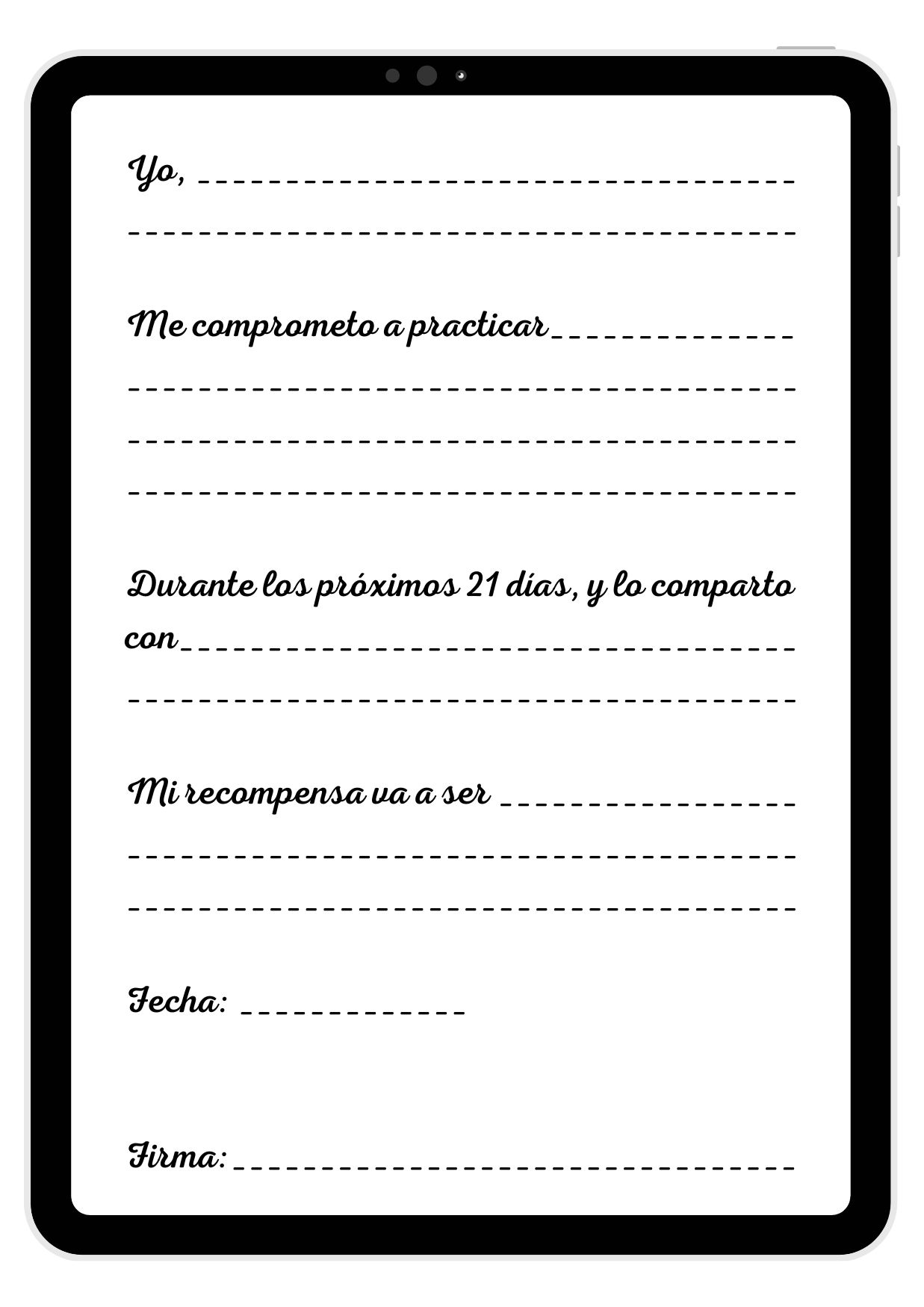
Documento the compromiso: "Yo, ... me comprometo a practicar... durante los próximos 21 días, y lo comparto con ... Mi recompensa va a ser ... Fecha: ... Firma: ..."
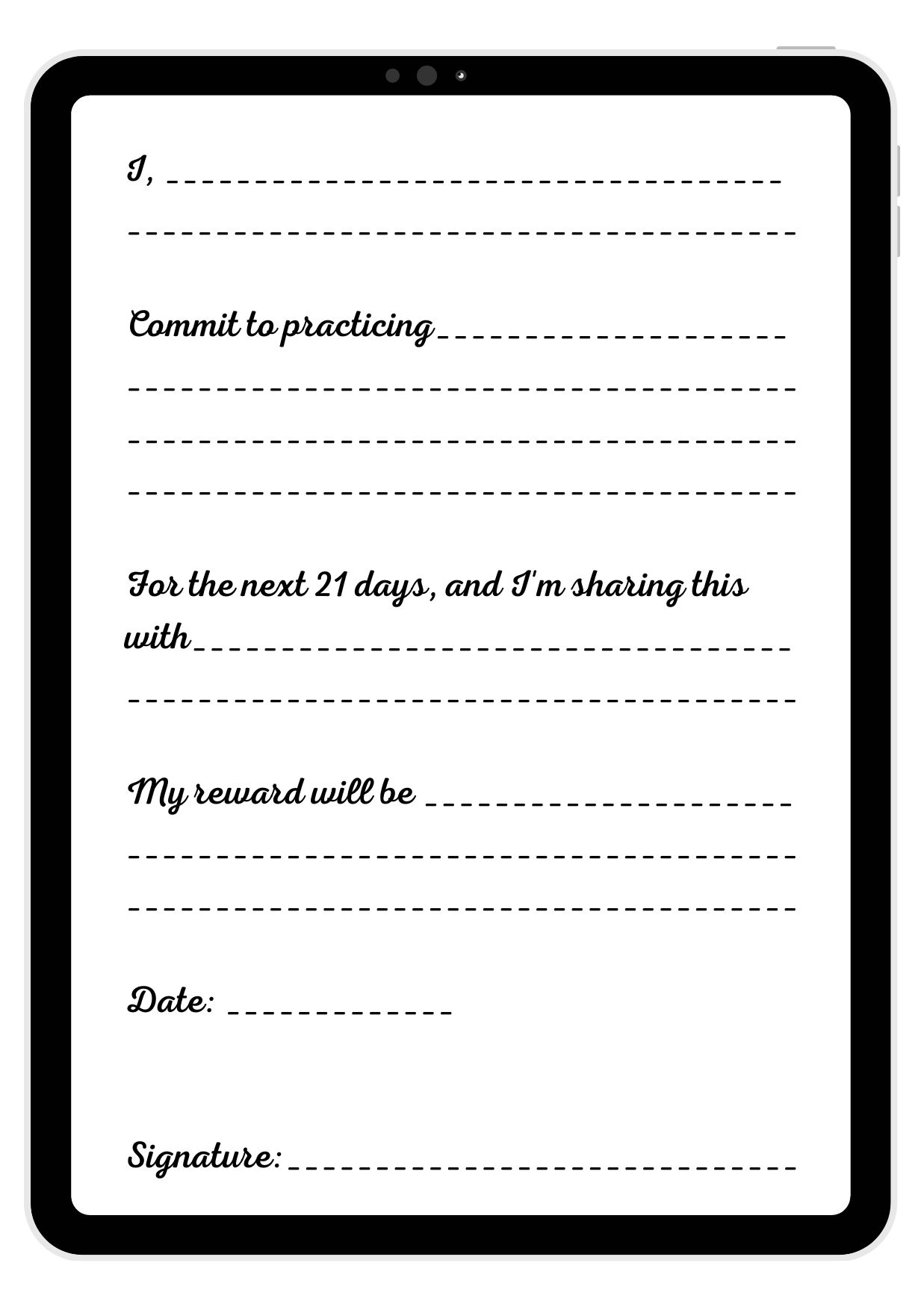
Commitment document: "I, ... commit to practicing... for the next 21 days, and I´m sharing this with... My reward will be... Date: ... Signature: ..."

A good start is half the work

Irish proverb