Today we´re adding another expression to our particular list of untranslatables. This time, the original is in English: to carve out time, and even though we have an expression with equivalent meaning in Spanish, sacar tiempo, which we could translate as "to extract time", I believe the English version paints a more vivid image, and therefore, it´s a. much more powerful metaphor .
Literally speaking, "to carve something out" involves working with a chisel and mallet, removing portions of a solid block of wood or stone, in order to give it a shape. As you can imagine, it´s a task that requires intention, attention and great skill; you need to have a very clear idea of what you intend to do, and have the knowledge on how to do it.
Now, transferring that concept to how we manage our time, we often find ourselves in a situation where our calendar is completely full, reflecting our responsibilities at work, at home, with our family, etc., plus another long list of tasks and commitments that we burden ourselves with (and we still don´t think it´s enough!). Our society nowadays values and rewards being super busy all the time, so we have normalised that way of life, together with the stress that comes along with it. "There are not enough hours in the day" is another go-to expression in English that´s a symptom of this big problem.
That´s why we find it so difficult to establish new habits to help us improve our health and wellbeing; we´re already exhausted, and we feel there´s no time for anything else. And that´s why I think this metaphor of the chisel and mallet is so relevant here: it´s not a question of simply "making time"; it´s about using that time strategically, building something with it, something that´s going to benefit us more than continuing to do everything the same way as before. And that requires intention, attention and a great skill, as well as consistency, to keep up the habit afterwards.
The reason I mention all this is because I´ve been wanting for some time to resume my old habit of reading, as I´ve kind of abandoned it in recent times. And want to resume it, among other reasons, because I believe it´s both more difficult than ever and more important than ever to keep it alive. I don´t have time right now to list all the benefits of reading (I encourage you to look them up, they´re impressive), but what I can do is share a quote from Dr. Seuss that I saw in a well-known bookstore in Dublin, and that I find very fitting:
"The more that you read, the more things you will know. The more that you learn, the more places you'll go".
What about you? What would you like to carve out time for? And what´s preventing you from doing it?
This past week, at work, I gave my first talk on the topic of instinctual biases, one of the two dimensions of the Awareness to Action model I mentioned a couple of months ago.
This part of the model describes three domains or areas of life that we all focus on without really noticing, as they are essential for our survival, and ultimately, for the survival of the human species. But the interesting thing is that we don´t realise how much attention we give to them (hence the word "instinctive", as they´re non-conscious tendencies), and even more interesting is the fact that this attention is not equally distributed among the three areas; instead, each of us prioritises one of them way above the other two (hence the word "biases", which are nothing more than tendencies to follow certain patterns).
Crucially, these instinctual biases are a determining factor in many of our decisions and everyday behaviours, so, going back to the analogy of the elephant from the other day, by being aware of these biases, we´ll be able to detect their influence on us, and work with them so that they help us instead of hindering us.
But before telling you about these three domains, there are two things I would like to clarify:
First, that us human beings are incredibly complex (and contradictory!), and there are a multitude of factors that influence our personality (remember the layers of the iceberg, and then add other aspects like family, culture, demographics, life experiences, etc., etc., etc.). This model doesn´t intend to explain everything about a person, not even remotely; that would be simply impossible. But it does explain several things that can provide significant value. As the famous quote attributed to George Box says: "all models are wrong; some models are useful".
Second: that this is not about labelling people, or putting them into boxes. It´s about realising that we´re already in a box, we´re already conditioned, and by being aware of that conditioning, we can make our "box" more flexible and adapt better to the circumstances at any given moment. So it´s not a question of defining who we are through this classification (or any other); it´s all about observing how we behave, and above all, the things we habitually do most of the time, so as to distinguish the moments when our auto pilot tends to get us into trouble or create misunderstandings.
In view of all this, the three instinctual domains in Awareness to Action are formulated as verbs, representing clusters of behaviours:
Preserving
Navigating
Transmitting
All these behaviours are, in reality, evolutionary adaptations we´ve inherited from our ancestors; they were useful to our ancestors, in the sense that they allowed them to survive at least long enough to reproduce, thus ensuring the continuity of our species.
Note: if you´re already familiar with the Enneagram through books or other schools or traditions, as there are several approaches, you may be familiar with other names used for the three subtypes under each Enneagram type. It´s not only the name that´s different here: chances are these concepts are broader than the ones you may have learned before, so you may need to do some "unlearning" to be able to grasp their full meaning and scope.
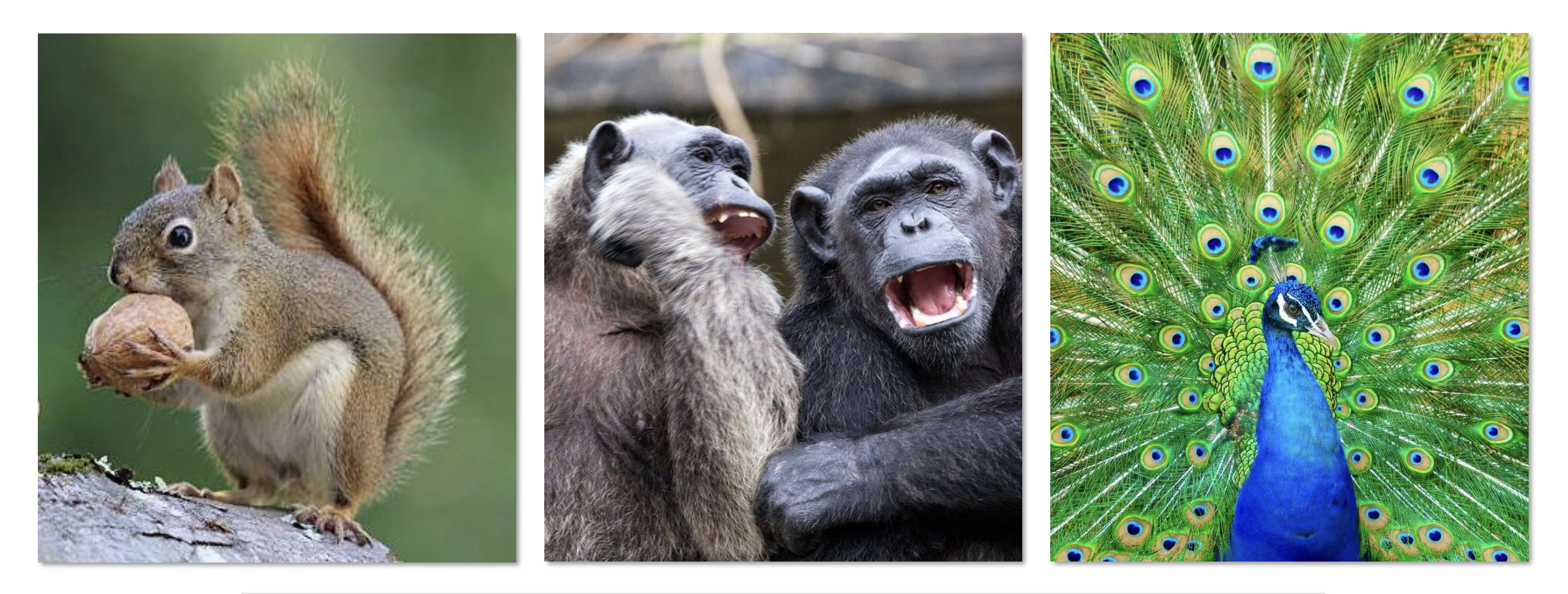
(Photos of a squirrel, two chimpanzees and a peacock, symbolising the three instinctual domains.)
We will get into more details for each instinctual domain and its corresponding bias in future articles; for now, let me give you some very broad strokes, including the symbols we use, which will hopefully help with understanding:
The preserving domain focuses on "nesting and nurturing", that is, making sure the fundamental survival needs are met, both for oneself and one´s family or close ones: for example, food, shelter and protection from external threats. It´s associated with the image of a squirrel, which we can visualise getting ready for the winter.
The navigating domain focuses on "orienting to the group", that is, understanding people and how they interact socially and within groups. Building alliances, creating trust and reciprocity, and understanding how oneself and others fit into the group. It´s associated with the image of some monkeys or chimpanzees, as these animals also form social groups with somewhat complex rules.
The transmitting domain focuses on "attracting and bonding", that is, behaving in ways that attract attention and leave a mark, so that they can transfer not only their genes (though that´s part of it as well), but also other things as their beliefs, values, interests and worldview to others, in order to make them carriers of that information. It´s associated with the image of a peacock, displaying its colourful and elegant feathers.
What do you think of these three domains? The are all necessary, and all of us do things in order to satisfy needs in all of the three areas.
But, as I said before, we don´t pay the same attention to all three of them: for some reason, we consider the needs related to one domain more important than those of the other two, and therefore, we prioritise the behaviours aimed at satisfying those needs. In a way, they become like a system of values we conform to without realising. And as a consequence, the other two areas are given lower priority, especially one of them, which always ends up at the bottom of the list... But we´ll talk about all of that in future articles.
Do you see yourself predominantly in one of these domains? Or maybe you´re torn between two, or even the three of them? As we get deeper and deeper into the model, hopefully the mystery will be solved... For the moment, as always, observation (and above all, self-observation) is the best exploration tool that will allow you to make interesting discoveries.
Ladies and gentlemen, today´s article is number 250 in BinaryWords 🙂
250 reflections on a variety of topics, linked by the same common thread: personal and professional growth, which, in my opinion, always go hand in hand.
I remember that, during the first few months of writing this blog, back in 2021, I used to get inspiration from the pictures and posters I had around the house to write some of the articles (like, for example here, here and here), as well as dusting off some quotes I had found in greeting cards, fridge magnets and even newspaper clippings or publicity leaflets. I realised that, without really noticing, I had been gathering inspiring materials for years, though I had never thought of sharing them until then.
And given that inspiration can be found literally anywhere, over the years, I´ve been developing the habit of staying always alert, with my radar on, and taking photos of interesting things I bump into when I´m out and about. I´ll admit that I´m a total disaster when it comes to taking pictures of people (and even a bigger disaster, if possible, when it comes to appearing in those pictures myself), but if you look at my gallery, you´ll see that it´s full of apparently random photos with the potential of maybe one day helping me to convey an idea.
Today, browsing that gallery, I found this photo of a poster I found in a shop years ago, comparing life to a photo camera. Interestingly, physical cameras are in fashion again nowadays, with their flash and their buttons, as opposed to taking photos with your phone... This new revival of old devices can be a topic for another day.
Well, here you go, I hope the simile is understandable in Spanish, even though some of the word plays get lost in translation:
Life is like a camera.
Focus on what is important.
Capture the good times.
Develop from the negatives.
And if things don´t work out - just take another shot.
The other day, I was talking to my work colleagues oabout the plot of this movie, Groundhog Day, whose title was translated into Spanish "Atrapado en el tiempo", that is, "trapped in time", because that´s precisely what it is about: the protagonist gets stuck on February 2nd, reliving the same day (Groundhog Day) again and again, not knowing how to get out of there.
(Photo of an ordinary bench in an ordinary park.)
And after that conversation, I kept thinking... It´s been a long time since I last heard someone say they feel like they´re living in Groundhog Day, in the sense of being stuck in a rut and wanting to get out of that monotony. Perhaps because life hasn´t felt particularly routine-like in the last while, and not necessarily for reasons we could identify as "good".
Instead, it feels like (or maybe it´s just me who´s feeling it) that everything is a bit out of control, be it because of inclement weather in the last few weeks, or because of the ever-increasing speed of progress of technology (e. g. AI), or because of so many other events happening in certain parts of the world, with situations reaching the point of becoming surreal.
Maybe we´re at a point where we would prefer our world to be a bit more stable and predictable.
But for the moment, we have what we have.
So, what can we do?
I can´t help but remember the beginning of the pandemic, back in March 2020 (almost six years ago!). At that time, everything was uncertain; we were also in a surreal situation, with no precedents, and we had no idea what the future would bring. But we had to keep going, and that´s what we did: we kept going, we muddled through, and step by step, with higher or lower degrees of suffering, we managed to walk that path and arrive at a new normality.
Maybe that´s what we need to do now as well, because it´s what human beings have had to do since the beginning of time: adapt to new situations, solve new problems.
They say that, in this life, the only constant is change, and we know that that´s true: people change over time, and also our environment and circumstances change. But the thing is, sometimes that change is softer and more gradual, and sometimes it´s a lot stronger and faster, so much so that it can overwhelm us. And that´s when the feeling (or rather, the illusion) of having everything under control crumbles down, only to be replaced by stress and uncertainty.
Our brain does not like uncertainty. It finds it really uncomfortable because it doesn´t know what to do with it, and since it can't solve it using its habitual autopilot, instead, it wastes tons of energy worrying and trying to predict the future. That´s the reason why we often prefer to revert to "the devil we know", to the rut and the monotony, rather than venturing towards what´s yet to be discovered, even though it could turn out better than what we have right now.
So, if you´re currently experiencing uncertainty of any kind, please know that you´re not alone; on the contrary. And even though there are external factors that we clearly can´t control, the good news is that we can use tools and strategies to help us feel better, and recover a certain sense of order and control. Here are a few suggestions:
Establishing "good" routines, which add stability, structure and predictability to our days, but keeping certain flexibility as well, so that we can adapt as things change around us.
Intentionally dedicating time to taking care of ourselves, physically, mentally and emotionally, including time on our calendars for leisure, rest, and connection (which, I´ve been reminded recently, are not luxuries, but actual needs). We can tackle anything better when our batteries are fully charged, and everything becomes a struggle when we´re feeling tired or in low spirits.
Keeping a diary (a physical one) to write (by hand) our thoughts and worries. The mere act of writing helps to bring out whatever we´re holding inside, become aware of it and process it better. Plus, our minds can now rest better, knowing it´s all written down.
What do you think about these three strategies? Which ones do you use when life moves at a faster pace than you would like?



 English (UK)
  Español